Product Features · Published April 5, 2026
job application tracker, resume profiles, ATS resume, cover letter tool, job search workflow. A tracker should do more than tell you where you applied.
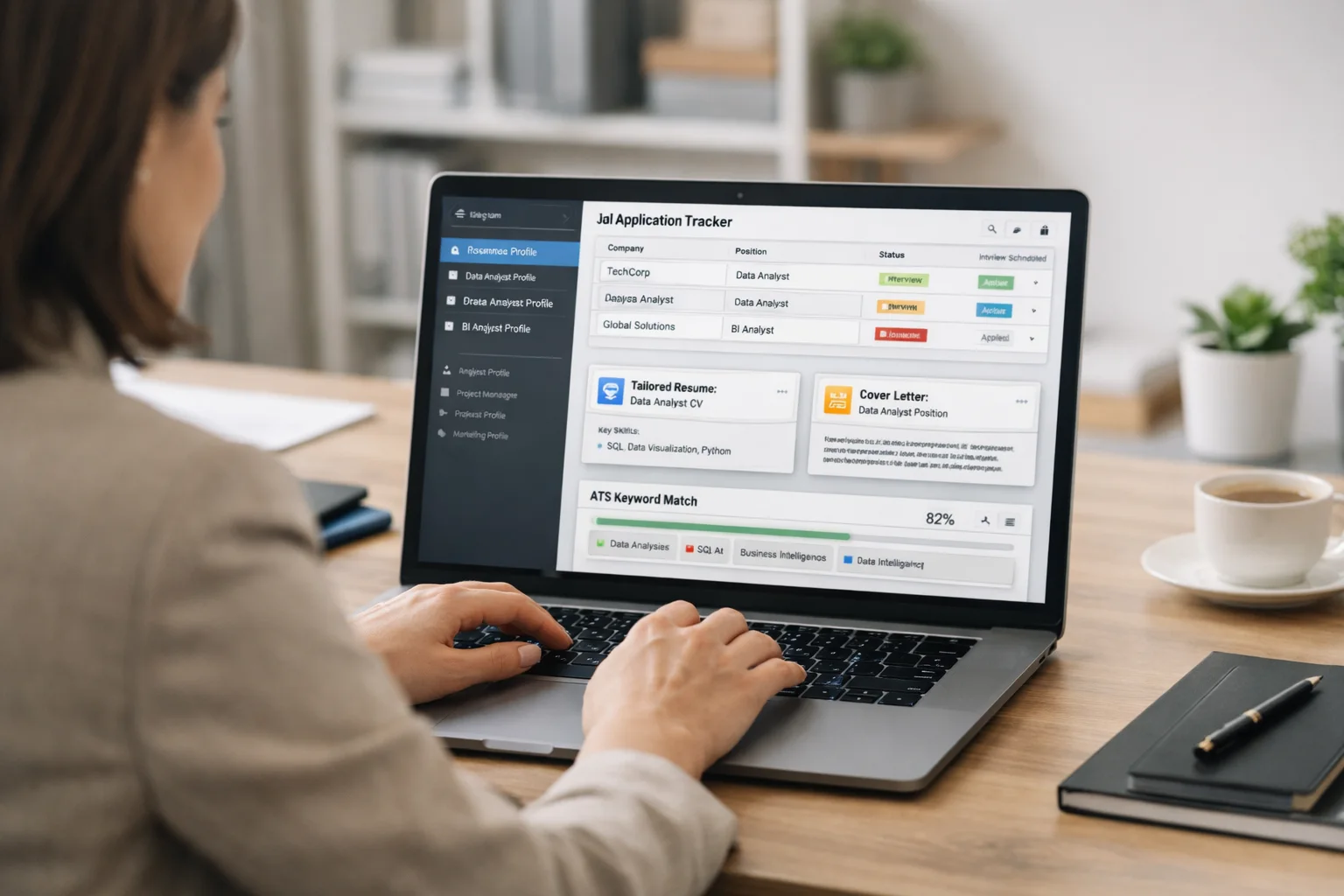
An AI job application tracker with resume profiles sounds like a small feature upgrade. In practice, it changes the whole workflow.
Most job seekers do not struggle to remember whether they applied. They struggle to remember what they sent, which version of their resume matched that role, what keywords they adjusted, and what to reuse when the next similar opening appears. That is where a basic tracker stops being enough.
A stronger system keeps your applications organized, but it also keeps your resume logic organized. That matters even more if you are applying across related roles, changing careers, targeting different countries, or sending a high volume of applications every week.
Short Answer
A good tracker should not just log jobs. It should connect each application to the right version of your story.
That is why resume profiles matter. Instead of rebuilding your positioning every time, you keep a few structured versions of your experience for different targets, then tailor from the right base. The result is faster applications, cleaner ATS alignment, and less risk of sending the wrong CV to the wrong employer.
What Most Trackers Get Wrong
A lot of trackers solve the visibility problem. You can see statuses, deadlines, follow-ups, and interview stages. That is useful, but incomplete.
The harder problem is version control.
Once you start tailoring applications seriously, your search gets messy fast:
- one resume for data roles
- another for operations or support roles
- a shorter version for startups
- a more conservative version for large employers
- slightly different summaries for local versus international applications
Without resume profiles, the tracker becomes a storage box with weak memory. You may know you applied to Company A on Tuesday, but not which positioning you used, which keywords were added, or whether that version is worth reusing.
That gap creates friction. It also creates mistakes.
The real value of a job tracker is not counting applications. It is reducing repeated thinking.
What to Look For in an AI Job Application Tracker With Resume Profiles
The best tools in this category do not treat tracking and tailoring as separate jobs. They connect them.
Here is what actually matters.
1. Separate resume profiles for separate job targets
This is the core feature.
If you are applying for more than one lane, a single master resume is not enough. You need profile-level structure. For example:
- Data Analyst profile
- BI Analyst profile
- Operations or Support profile
- Early-career version
- International-friendly version
That lets you start from a relevant base instead of rewriting from scratch every time.
2. Tailoring linked to the actual application
A tracker becomes far more useful when each application is tied to the tailored CV, cover letter, and supporting notes for that role.
Otherwise, your documents live in scattered folders while the tracker only shows status labels. That is not much better than a spreadsheet.
3. ATS guidance that is practical, not theatrical
Keyword guidance is useful when it helps you close obvious gaps and improve phrasing. It is less useful when it turns into fake precision.
You want a tool that helps you spot missing language, align skills more clearly, and export a clean version. You do not need a performance dashboard that gives you the illusion of certainty.
4. Saved history and PDF-ready output
Repeated applicants need retrieval, not just generation.
If a past version worked well, you should be able to find it quickly, reuse it, and export it cleanly without rebuilding the document from zero.
5. A workflow built for applying often
This is where many general AI tools fall short. They can help with a draft, but they do not naturally maintain the full application process.
If your workflow still requires blank prompts, manual file naming, extra note-taking, and a separate tracker, the tool is only solving part of the job.
Why Resume Profiles Matter More Than People Expect
Resume profiles sound administrative. They are actually strategic.
They help you answer a simple question: Which version of me is this job supposed to see?
That matters because most applicants are not truly one-dimensional. A career changer may have overlapping strengths across functions. An international applicant may need one version that emphasizes tools and another that emphasizes business outcomes. A high-volume applicant may need one profile for junior roles and another for mid-level roles.
Without profiles, you end up doing one of two bad things:
- sending the same generic resume everywhere
- manually rebuilding the same few versions over and over
Both waste time. Both weaken consistency.
With profiles, your applications become more deliberate. You still tailor for each role, but you tailor from the right starting point.
Where HireDraftAI Fits
HireDraftAI is strongest when you want a structured application workflow rather than a blank AI writing space.
Instead of jumping between separate tools for drafting, ATS guidance, exporting, and tracking, you can keep the process in one place: tailored CV generation, matching cover letters, ATS feedback, PDF-ready exports, saved document history, resume profiles, and application tracking.
That makes it a practical fit for people who apply repeatedly and want to move faster without letting quality collapse.
You can see how the workflow works on the HireDraftAI homepage.
Who This Setup Is Best For
An AI job application tracker with resume profiles is especially useful for:
- active job seekers applying to multiple roles each week
- career changers who need different positioning for adjacent roles
- international applicants adjusting for different employer expectations
- professionals who want to reuse strong resume bases without sending generic applications
- anyone tired of managing folders, filenames, and spreadsheets by hand
It is less essential if you are applying to only a handful of highly similar roles and are happy managing everything manually.
Realistic Scenarios
You are applying across two related job families
Maybe you are targeting both data analyst and BI analyst roles. The overlap is real, but the emphasis changes. Resume profiles keep both paths clean without forcing a full rewrite every time.
You want speed without looking generic
The usual failure mode in high-volume applications is obvious: speed goes up, quality goes down. A structured profile-based workflow helps you move faster while preserving relevance.
You have good raw experience but weak process
Many people do not need better experience. They need better packaging and better follow-through. A connected tracker helps with both.
The Mid-Search Test
A simple way to judge your current setup is this:
If you applied to 25 roles last month, can you instantly answer all five of these questions?
- Which resume version went to each one?
- Which applications used your strongest positioning?
- Which keywords kept repeating across the best-fit roles?
- Which cover letter version is worth reusing?
- Which profile is getting the best response rate?
If the answer is no, you do not just need a tracker. You need a better system.
That is the case for using a structured workflow tool instead of cobbling together prompts, files, and notes by hand.
Approved Free Tool CTA
Check the exported file before uploading it to an application portal.
Primary free tool: resume file technical health check.
Source and Editorial Note
This article was reviewed after manual SEO approval on 2026-07-05. It uses official and primary references where claims need grounding, and it avoids claiming that a resume score, keyword tool, or AI workflow can guarantee interviews.
Final Verdict
The best AI job application tracker with resume profiles does not just help you remember where you applied. It helps you apply with more consistency, more relevance, and less wasted effort.
That is the real distinction.
A basic tracker is a record. A better one becomes part of your application engine.
If your search involves repeated applications, multiple target roles, or constant resume adjustments, resume profiles are not a nice extra. They are the feature that makes the tracker truly useful.
For job seekers who want that workflow in one place, HireDraftAI is worth a close look, especially if you want tailored CVs, cover letters, ATS guidance, saved versions, and tracking connected from the start. You can review the workflow and plans on the pricing page.