Use Cases · Published April 19, 2026
AI can speed up the draft, but it cannot make a tech career change credible by itself. What matters is whether your letter shows proof, relevance, and a realistic reason this move makes sense now.
What Makes a Tech Career-Change Cover Letter Credible
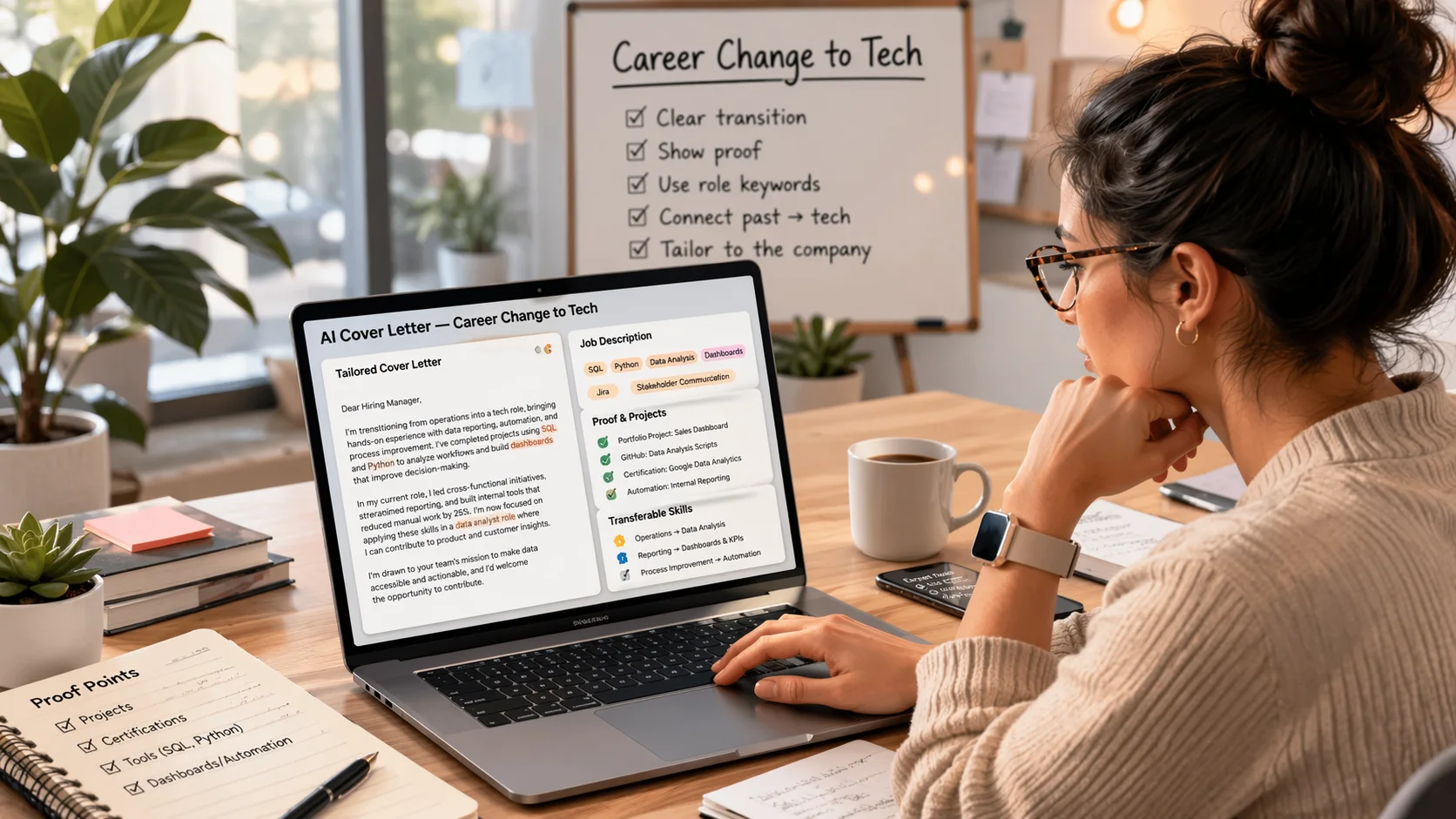
An AI cover letter for career change to tech can save time, but only if it helps make the transition sound credible.
That is the real standard. Hiring teams do not need a long story about why you now “love technology.” They need a short, confident explanation of the move, proof that it is already underway, and evidence that parts of your previous work still matter in this role.
Why AI Cover Letters for Career Changers Often Fail
Most weak AI-generated cover letters fail in predictable ways.
They over-explain the transition. They lean on personality instead of proof. They sound apologetic about missing direct experience. Or they reuse broad language that could be sent to almost any employer.
For a move into tech, that usually backfires. The strongest letters are not defensive. They are selective. They frame the shift clearly, show applied evidence, and connect past work to current fit.
In a tech career-change letter, proof matters more than enthusiasm.
What an AI Cover Letter for Career Change to Tech Must Include
1. A clear explanation of the transition
Do this early, and do it once.
The best version is brief: what role you are targeting, what field you are coming from, and why the move is already practical rather than hypothetical.
A strong line sounds like a professional transition already in motion. A weak line sounds like a personal essay.
2. Proof that the transition is already real
This is where many letters either win or collapse.
Useful proof can include:
- projects
- certifications
- GitHub work
- dashboards or automations
- documentation or troubleshooting experience
- internal tools work in a non-tech role
- reporting, QA, testing, or process improvement work
If you are moving into tech, this matters far more than saying you are motivated. Motivation explains interest. Proof explains credibility.
3. Transferable achievements rewritten in tech-relevant language
Do not copy old responsibilities and hope AI makes them sound modern. Translate them.
For example:
- teacher to tech support: user guidance, troubleshooting, documentation, training
- operations to data: reporting, KPI tracking, process analysis, data checks
- customer service to QA or support: ticket handling, issue triage, escalation discipline
- finance or admin to systems roles: accuracy, workflow ownership, tool adoption, cross-team coordination
The goal is not to pretend your old job was technical. The goal is to show that parts of your previous work already map to the role you want.
4. Keywords that match the target role
If the job description mentions SQL, Jira, dashboards, Python, SaaS support, testing, documentation, stakeholder communication, or ticketing, your letter should reflect the terms that genuinely apply to you.
This is one of the best uses of AI. Not invention. Alignment.
Before you draft anything, pull out the 5 to 8 terms that appear most central to the role and match them only where you can defend them honestly.
5. A specific reason this company makes sense
Even one sentence helps.
Why this product, team, customer problem, or environment? Why this role shape instead of any general tech job?
That detail keeps the letter from sounding mass-produced, which is exactly where many AI-assisted drafts fall apart.
Getting those five elements right is the foundation. The next question is how to use AI to build them efficiently without flattening your story into something generic.
How to Use AI Without Sounding Generic
Use AI as a reviewer and organizer, not as a machine that writes your story for you.
Give it:
- your real resume
- the full job description
- 3 to 5 proof points you can actually defend
- the tech role you are targeting
- clear instructions not to invent experience
Then use it to do useful work:
- identify transferable strengths
- spot missing keywords
- tighten vague phrasing
- remove apologetic language
- check whether the cover letter and resume tell the same story
That workflow is much stronger than asking for “a cover letter for a tech job.”
A Simple Structure That Usually Works
You do not need a clever structure. You need a believable one.
- Opening: state the role, the transition, and why you are relevant now.
- Middle: show proof that the move into tech is already happening.
- Next paragraph: connect older achievements to the target role.
- Closing: explain why this company and invite next steps.
If you are applying repeatedly, the real challenge is usually not writing one letter. It is turning job descriptions into matched documents and keeping that workflow consistent across many applications.
What to Leave Out
A better career-change cover letter is often shorter because it removes weak material.
Leave out:
- long explanations of why you became unhappy in your old field
- broad claims about being passionate about technology
- unsupported words like expert or highly skilled
- every course or tutorial you completed
- generic lines that could fit any employer
The letter should sound like someone already moving into tech, not someone asking for permission to start.
Approved Free Tool CTA
Run the cover letter check after your final edit, not before you add role-specific proof.
Primary free tool: cover letter checker.
Source and Editorial Note
This article was reviewed after manual SEO approval on 2026-07-05. It uses official and primary references where claims need grounding, and it avoids claiming that a resume score, keyword tool, or AI workflow can guarantee interviews.
- CareerOneStop resume guidance
- CareerOneStop cover letter guidance
- Google people-first content guidance
FAQs
Can AI write a good cover letter for a tech career change?
It can help, but not on its own. AI works best when you give it real proof points, a specific job description, and clear instructions not to invent experience.
Should you say directly that you are changing careers?
Usually yes, but briefly. The goal is to frame the move clearly and then move quickly into evidence that the transition is already underway.
What proof matters most in a tech career-change cover letter?
Projects, certifications, reporting work, automation, troubleshooting, documentation, internal tools experience, and any applied work that maps directly to the target role.
Can projects and certifications replace direct tech experience?
They can strengthen credibility, especially when direct experience is limited. They work best when paired with transferable results from your previous field.
How long should a tech career-change cover letter be?
Usually three short paragraphs is enough. The goal is not to tell your whole story. It is to make a believable case for fit.
Final Verdict
A strong AI cover letter for career change to tech does not try to hide your previous background. It uses that background carefully, adds real proof, and makes the transition feel practical instead of hopeful.
That is why the best results usually come from a structured workflow, not just faster generation. If you are managing repeated applications during a move into tech, HireDraftAI can help make resume matching, cover-letter tailoring, and saved versions easier to manage in one place.