Cover Letter and Outreach · Published July 10, 2026
Free Cover Letter Checker Online helps applicants who already drafted a letter and need a quality check move from scattered advice to a specific, truthful application workflow.
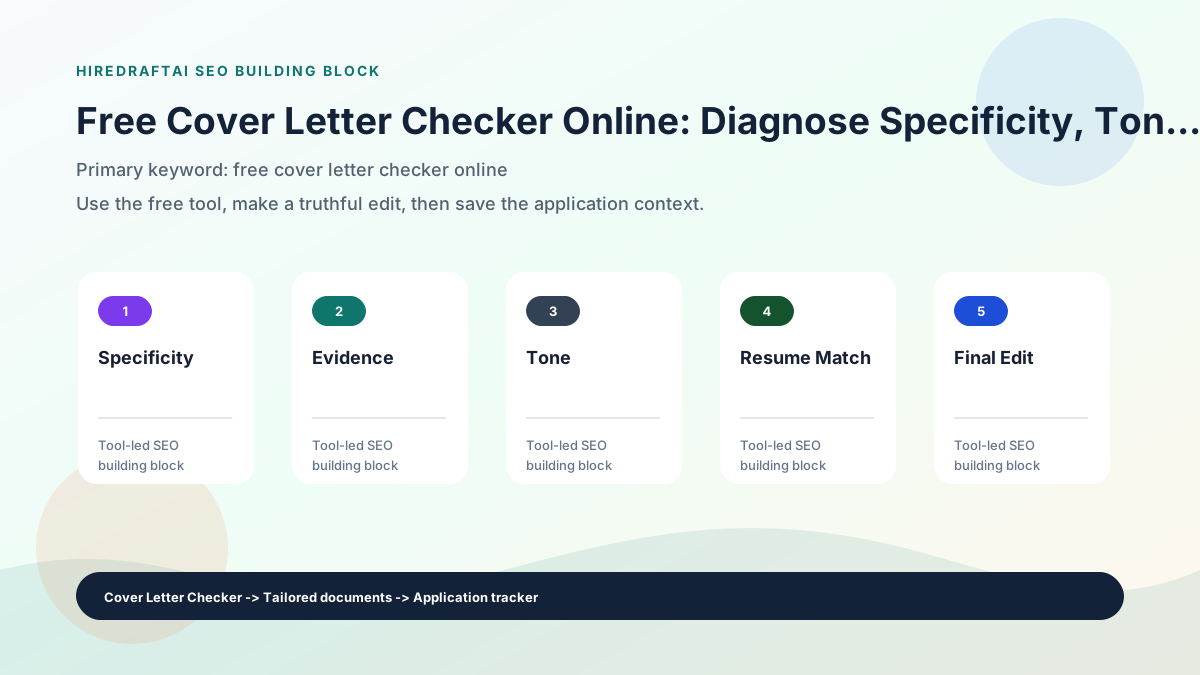
If you searched for free cover letter checker online, you are probably not looking for a motivational career article. You are trying to make one practical decision: how to improve a real application without wasting time or making claims you cannot defend.
That is the purpose of this guide. It takes the narrow keyword seriously, but it does not stop at the keyword. The goal is to help applicants who already drafted a letter and need a quality check use Cover Letter Checker, interpret the result, make a better application decision, and keep the context attached to the role.
The problem is specific: a polished letter can still be too generic. A tool can surface that problem quickly, but the useful work happens when the applicant turns the finding into a truthful resume edit, cover letter adjustment, outreach message, or tracker note.
The promise is simple: check for role specificity, supported claims, tone, and resume alignment before sending. HireDraftAI fits because the product is built around the full application package: role context, tailored resume, matching cover letter, ATS-aware checks, saved document history, and job application tracking.
Quick Answer
The best way to use free cover letter checker online is to treat it as one step in a workflow, not the whole workflow. Start with the real job description, run the relevant free tool, decide which recommendations are truthful, and then save the final document version with the application record.
Use Cover Letter Checker when you need the first diagnostic or draft. Use ATS resume checker, resume keyword matcher, and job description keyword extractor when the application needs a broader quality check. Use the HireDraftAI application workspace when the same role also needs a tailored resume, matching cover letter, export, saved history, and tracker entry.
The decision rule is direct: if you only need one isolated check, a free tool may be enough. If you are applying repeatedly, the value comes from connecting the check to the document version and the outcome.
- Best immediate action: run Cover Letter Checker on one real role, not a fake sample.
- Best quality gate: keep only recommendations supported by real experience.
- Best workflow upgrade: save the tailored resume, cover letter, score notes, and status together.
- Best trust rule: no keyword, phrase, or AI-generated claim should enter the application unless you can explain it in an interview.
Source and Editorial Note
This article was built as a people-first SEO resource for HireDraftAI readers, not as a keyword-only page. It uses the sources below to keep the guidance grounded and avoids claiming that any resume, ATS score, or keyword tool can guarantee an interview.
- CareerOneStop cover letter guidance - CareerOneStop explains when cover letters help clarify match, motivation, employment gaps, and special interest in a role.
- CareerOneStop job search plan - CareerOneStop recommends planning the search, targeting materials, tracking activity, and following up where appropriate.
- CareerOneStop resume guidance - CareerOneStop is sponsored by the U.S. Department of Labor and provides practical resume guidance for job seekers.
- Google guidance on AI-generated content - Google says AI can help with structure and research, but scaled content without added value can violate spam policies.
Editorially, the recommendation is based on the job seeker's practical outcome: a more specific application, a cleaner record of what was sent, and fewer unsupported claims. Exact keyword demand should still be checked in Search Console and keyword tools during ongoing SEO review.
Who This Guide Is For
This guide is for applicants who already drafted a letter and need a quality check. It is especially useful when the application matters enough to deserve tailoring, but not so much manual work that every role becomes a fresh writing project.
It is also for people who have tried generic AI prompts, resume templates, or spreadsheet trackers and noticed a common failure: each tool helps for a moment, but the job description, resume evidence, cover letter, file export, and follow-up record drift apart.
The advice below assumes you want a strong application, not an artificial score. Scores, scans, and generators can guide the work. They cannot replace judgment about fit, honesty, clarity, and whether the role is worth your time.
The Real Problem Behind the Keyword
The surface topic is a search for free cover letter checker online. The deeper problem is decision quality. A job seeker does not only need a cleaner sentence or a higher score. They need to know what to change, what to leave alone, and what the change means for the actual application.
That is why thin advice fails. A page that only says "add keywords" or "tailor your resume" does not help a candidate decide whether a missing term is a harmless wording gap, a trainable skill gap, or a true mismatch. Those three situations require different actions.
A world-class workflow slows down at the right moments. It asks whether the job post is worth applying to, whether the resume contains proof, whether the cover letter supports the same story, and whether the final version is saved somewhere useful.
Practical Example: a marketing assistant checking whether the letter explains why this brand and why this role
Imagine a marketing assistant checking whether the letter explains why this brand and why this role. The applicant has a real role in front of them, not a theoretical job title. The posting contains specific requirements, preferred skills, and hints about how the employer describes the work.
A weak workflow jumps straight to rewriting. The applicant pastes the job post into a generic AI chat, accepts a polished draft, downloads a file, and hopes the new wording is better. That may create a nicer document, but it does not create a reliable application system.
A stronger workflow starts by identifying the decision. For this applicant, the question is not "Can AI make this sound better?" The question is "Which parts of my real background are most relevant to this role, and how should they appear in the resume, letter, and tracker?"
That difference matters after the application is sent. If the applicant gets an interview, they can explain every claim. If the application gets no response, they can review the role fit, document version, source, and follow-up timing instead of guessing what went wrong.
How to Use Cover Letter Checker Without Creating Generic Output
Open Cover Letter Checker with one real job description and one real resume, draft, message, or profile section. Do not start with a vague target like "marketing jobs" or "remote roles." The tool is most useful when the input is specific.
Read the output as a set of decisions, not commands. If the tool flags missing language, ask whether the experience is actually present. If it suggests a stronger phrase, ask whether you would be comfortable explaining that phrase to a recruiter. If it produces a draft, check whether the draft uses your evidence or generic filler.
Then choose the smallest edit that makes the application clearer. Most strong applications are not complete rewrites. They are better ordered, more specific, and more consistent with the role. That means changing the summary, reordering skills, rewriting two bullets, tightening the cover letter, or adding a follow-up note.
Finally, save the result. This is where HireDraftAI has a product advantage over isolated tools. When a generated document, ATS note, and tracker entry stay attached to the role, the job search gains memory. The next similar application starts with context instead of repetition.
- Input one real job description and one current resume or draft.
- Mark recommendations as supported, unsupported, or unclear.
- Rewrite only the sections that improve role fit.
- Run a final check for readability, truth, and file quality.
- Save the final version with the company, role, date, and status.
The Five-Step Workflow
Use this workflow whenever this topic matters enough to influence the final application.
- Specificity: start by tying the task to one real job description instead of a generic role title, because every useful decision depends on the actual posting.
- Evidence: compare the requirement with evidence already present in the resume, profile, project history, or interview notes before adding new wording.
- Tone: separate wording gaps from experience gaps so the applicant knows what can be rewritten and what should simply be treated as a limitation.
- Resume Match: make the edit in a place a recruiter can understand quickly: summary, skills, selected bullets, cover letter, or tracker note.
- Final Edit: save the decision with the application record so the next similar role starts from a better baseline rather than a blank page.
The sequence matters because it prevents a common mistake: optimizing a sentence before understanding the role. The job description should define the target. Your real experience should define the boundaries. The tool should speed up the work inside those boundaries.
Before and After Examples
These examples show the kind of rewrite standard to aim for. They are not magic phrases to copy. They show how to move from vague activity to role-specific evidence.
- Weak: "I am excited to apply because your company is a great opportunity."
- Stronger: "I am interested in this role because it combines the stakeholder coordination and launch tracking work I have already handled in fast-moving teams."
- Weak: "My resume shows I am a perfect fit."
- Stronger: "The strongest match is my experience turning unclear requests into documented next steps, which connects directly to the role's emphasis on cross-team execution."
- Weak: "Please consider me for any open role."
- Stronger: "I am reaching out about this specific opening because the requirements align with my recent work in reporting, process follow-up, and customer-facing communication."
The stronger versions work because they add context and responsibility without pretending the candidate did something they did not do. That is the difference between optimization and exaggeration.
A useful rule is to make every edit answer one of three questions: what changed, how you contributed, and why the employer should care. If a sentence cannot answer at least one of those questions, it probably belongs in notes, not in the final application.
What to Add, Ignore, Rewrite, or Track
Add information when the job description asks for something you genuinely have and the resume currently hides it. That may be a tool, method, customer type, reporting responsibility, remote collaboration pattern, or measurable outcome.
Ignore suggestions that are not supported by your experience. A missing keyword is not always a defect. Sometimes it is a signal that the role is not a strong fit or that the term belongs in interview preparation rather than the resume.
Rewrite text when the evidence exists but the wording is too broad. This is the most common opportunity. A candidate may have led handoffs, built reports, trained users, documented processes, or coordinated stakeholders without using the employer's vocabulary.
Track the final decision. If you add a keyword, rewrite a summary, change a bullet, or send a follow-up, record it with the application. The tracker becomes useful only when it can explain what was sent and why.
Common Mistakes
- Treating a score as a guarantee. No resume score can promise an interview, and strong applications still depend on role fit, timing, market conditions, and employer judgment.
- Adding unsupported keywords. This can make the resume look aligned while making the interview harder.
- Letting the cover letter tell a different story from the resume. The letter should reinforce the same fit, not introduce a new identity.
- Forgetting the file and tracker step. A good draft is incomplete if the exported file is confusing or the application record does not show which version was sent.
- Chasing every long-tail variation. If two queries require the same answer, one excellent guide is better than multiple thin pages.
The last mistake is especially important for SEO and trust. HireDraftAI should build topical authority by publishing distinct, helpful resources. The purpose of this article is not to capture every wording variation. It is to answer one real search intent completely.
Where HireDraftAI Fits
HireDraftAI is strongest after the first insight appears. A free tool can identify a gap, draft a section, or score a piece of writing. HireDraftAI turns that insight into a connected application package.
For this topic, the practical path is: run Cover Letter Checker, use job description keyword extractor or resume keyword matcher when the job language needs more review, generate or edit the tailored resume, create a matching cover letter, export clean files, and save the record in the tracker.
That workflow matters because job seekers rarely apply once. They apply across role families, companies, and weeks. Saved history helps them reuse strong choices, avoid repeated admin work, and learn from response patterns.
If you are deciding whether the full workflow is worth it, compare one real application manually against the same application in HireDraftAI. The test is whether you end with clearer documents and a better record, not whether the first draft sounds impressive.
Internal Resources to Use Next
Use this article as one building block in the larger HireDraftAI SEO and product system.
- Run the primary tool: Cover Letter Checker.
- Check broader ATS and keyword fit: ATS resume checker, resume keyword matcher, and job description keyword extractor.
- Start with a spreadsheet-style baseline if needed: job application tracker template.
- Compare the full workflow and paid plan: HireDraftAI pricing.
- Read related workflow guides: ai cover letter matched resume, cover letter too generic for ats make it role specific, struggling to write an ats optimized cover letter use this checklist.
The recommended next action is to make the message match the resume version and save it with the application. That is how this article supports both user value and long-term topical authority.
Quality Checklist Before You Send
Before you submit the application, run this short checklist. It is intentionally practical because a final application is judged by clarity, truth, and relevance.
- The resume is tailored to the actual job description, not only the job title.
- Every important keyword is supported by real experience, coursework, projects, or tools you have used.
- The strongest evidence appears high enough for a recruiter to notice quickly.
- The cover letter supports the same role story as the resume.
- The file name is clear and the exported file is readable.
- The application tracker includes company, role, source, date, status, document version, and next follow-up.
- You can explain every claim in an interview without reading from the document.
How to Measure Whether This Worked
Do not judge this workflow by one application. Judge it by whether the next five applications become clearer, faster, and easier to review.
Track the roles where you used this process. Note the role family, resume version, cover letter version, score or checklist result, application source, follow-up date, and outcome. The pattern matters more than one result.
If response quality improves, preserve the winning language and reuse the structure for similar roles. If responses do not improve, review whether you are targeting weak-fit roles, using unsupported keywords, or sending documents that do not match the employer's requirements.
This is where a connected workflow beats a folder full of PDFs. The tracker turns applications into feedback. Without that record, every application feels like a separate event and the search gets harder to improve.
When Not to Over-Optimize
Do not over-optimize low-fit roles. If the job requires core experience you do not have, a higher keyword score may only make the application less honest.
Do not over-optimize language at the expense of readability. A resume full of exact job-post terms can become harder to skim, especially if the terms are stacked without evidence.
Do not create a new resume identity for every posting. Use profiles or role tracks to stay organized. The goal is specific positioning, not a different professional story every day.
Final Recommendation
Use free cover letter checker online as a practical step toward a stronger application, not as a shortcut around judgment.
Start with Cover Letter Checker. Apply the five-step workflow. Keep only truthful edits. Then connect the final resume, cover letter, and follow-up plan inside HireDraftAI so the application has memory.
That is the difference between a quick content fix and a serious job-search system. A content fix improves one sentence. A system improves the next application because it preserves context, decisions, and outcomes.
The best version of this workflow gives the job seeker more control: clearer writing, fewer generic claims, better tracking, and a record that makes the next role easier to handle.
Intent Boundary
This page is intentionally scoped to Free Cover Letter Checker Online: Diagnose Specificity, Tone, and Fit. It should not compete with a broader pillar, comparison, or tool hub. Use this guide when that exact scenario is the problem; use cover letter checker when you need the first practical diagnostic before editing.
Approved Free Tool CTA
Run the cover letter check after your final edit, not before you add role-specific proof.
Primary free tool: cover letter checker.
FAQs
What is the best way to use free cover letter checker online?
Use it with one real job description and one real resume, draft, message, or profile section. Run the relevant tool, keep only truthful recommendations, rewrite the highest-impact parts, and save the final version with the application record.
Is a free tool enough?
A free tool is enough for a quick check, first draft, or narrow diagnosis. It is usually not enough when you need tailored resumes, matching cover letters, exports, saved history, and tracking across many applications.
How do I avoid keyword stuffing?
Only use keywords that describe experience you can defend. Place them in normal resume sections where they connect to proof, not in a block of disconnected terms.
Should I tailor every application?
Tailor every serious application, but do not rewrite everything. Change the summary, skills, strongest bullets, and cover letter focus where the job description clearly asks for different evidence.
Where should I start in HireDraftAI?
Start with Cover Letter Checker. Then use the full HireDraftAI workflow when you want the tool result connected to a tailored resume, matching cover letter, clean export, saved version, and tracker entry.
What should I track after applying?
Track company, role, source, date applied, document versions, status, follow-up date, and outcome. The tracker becomes more valuable when it connects results to the exact documents and decisions used.