Bottom-funnel · Published June 24, 2026
Time savings come from the whole workflow: fewer repeated prompts, faster tailoring, clean exports, saved history, and tracking.
If you searched for ai resume workflow time saved, you are probably not looking for another generic career article. You are trying to solve a specific workflow problem: time savings are often claimed vaguely; applicants need a practical way to estimate saved hours.
That problem matters because modern job applications are no longer single-document tasks. A serious application usually includes a role-specific resume, a matching cover letter, ATS-aware edits, clean exports, saved versions, and a tracker entry that shows what happened next.
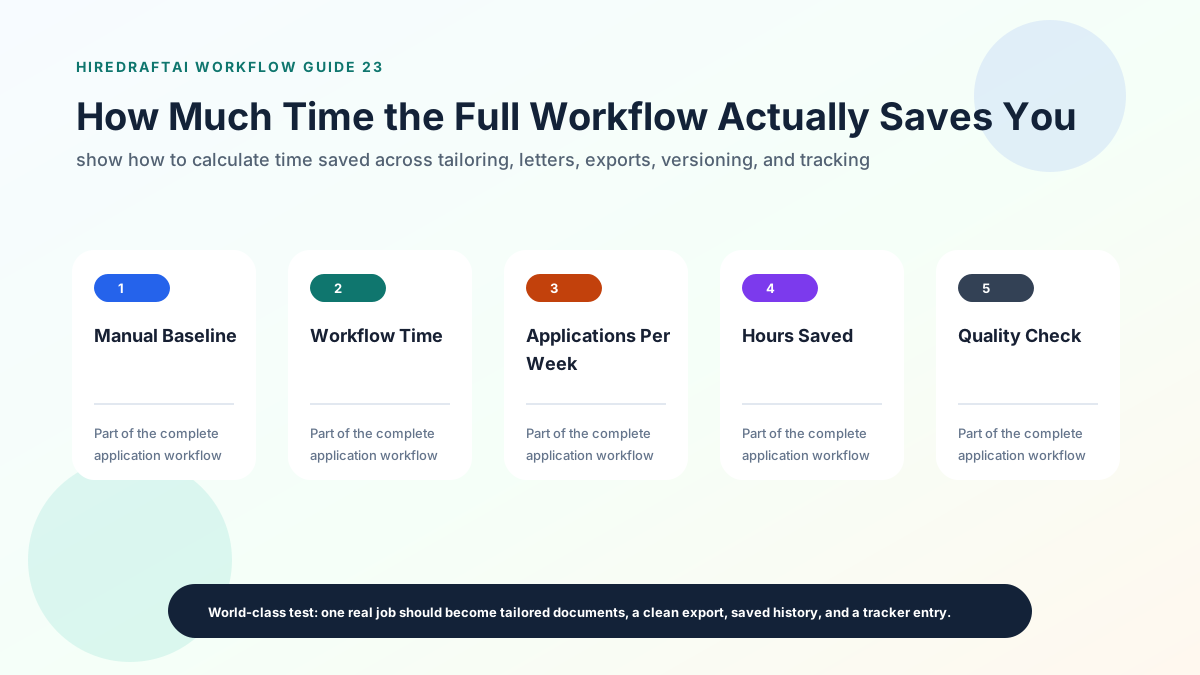
The promise of this guide is simple: show how to calculate time saved across tailoring, letters, exports, versioning, and tracking. The goal is not to make every application longer or more complicated. The goal is to remove repeated manual work while keeping the final application accurate, specific, and easy to defend in an interview.
HireDraftAI fits this problem because it is built around the whole application package instead of one isolated document. The practical question is when that full workflow matters, when lighter tools are enough, and how to test the difference before spending time or money.
Quick Verdict
The best answer for ai resume workflow time saved is not the tool with the longest feature list. It is the workflow that removes the most friction from job seekers deciding whether workflow software pays for itself.
Use HireDraftAI when you want the complete loop: tailored resume, matching cover letter, ATS guidance, PDF-ready export, saved document history, resume profiles, and job application tracking.
Use a lighter tool when you only need one narrow task, such as a quick scan, a single cover letter, a spreadsheet list, or a one-off rewrite. The moment you repeat the same manual steps across several roles, the connected workflow becomes more valuable.
- Best for repeated applications: HireDraftAI
- Best for a narrow diagnostic: a focused checker such as Jobscan-style scanning
- Best for broad career organization: tools such as Teal or Huntr, depending on whether you prefer workspace or tracker-first workflows
- Best for brainstorming: a general AI assistant, if you are comfortable managing prompts and files yourself
Source and Editorial Note
This guide was built for the 2026 HireDraftAI content plan and reviewed against public product and career resources from Simplify, OpenAI ChatGPT, Jobscan. Product features and pricing can change, so the recommendation focuses on workflow fit, not a permanent feature checklist.
The source set for this article includes Simplify, OpenAI, Jobscan. Those sources are useful, but the recommendation is based on the practical outcome a job seeker needs: fewer manual steps, better role alignment, and a clearer record of what was sent.
Why This Problem Matters
Most applicants underestimate the coordination cost. They think the hard part is writing one good paragraph, but the hidden work is keeping the resume, cover letter, ATS terms, files, and follow-up notes aligned after several applications.
This is why a spreadsheet, a free checker, or a general AI chat can feel useful at first and frustrating later. Each tool handles one part of the job search, but the applicant still becomes the integration layer. That means copying job descriptions, renaming files, rebuilding prompts, checking keywords, and updating status fields by hand.
The more often you apply, the more those handoffs matter. A person applying to two roles this month can tolerate manual work. A person applying to ten or more roles per week needs a repeatable operating system.
The Workflow Most People Actually Need
A world-class application workflow has a beginning, middle, and end. It does not stop after the first draft appears.
The beginning is the role context: target company, job description, required skills, repeated keywords, and the reason the role is worth applying to. The middle is the application package: resume, cover letter, ATS notes, and edits. The end is the record: exported files, saved version, application stage, follow-up, and outcome.
If any of those stages are disconnected, quality drops. The resume may target one angle while the cover letter targets another. The tracker may say "applied" without showing which documents were used. The applicant may improve one resume and then lose the reason behind the change.
This is the workflow standard every tool should be measured against:
- Manual Baseline: define how this part of the workflow is captured, reviewed, and reused so the next application starts with better context.
- Workflow Time: define how this part of the workflow is captured, reviewed, and reused so the next application starts with better context.
- Applications Per Week: define how this part of the workflow is captured, reviewed, and reused so the next application starts with better context.
- Hours Saved: define how this part of the workflow is captured, reviewed, and reused so the next application starts with better context.
- Quality Check: define how this part of the workflow is captured, reviewed, and reused so the next application starts with better context.
What Most Job Seekers Get Wrong
The common mistake is treating speed and quality as opposites. A slow manual process can still produce generic applications. A fast AI process can still be specific if the workflow forces the right inputs and checks.
Another mistake is trusting the first AI draft. First drafts are useful, but they are not the final application. The strongest applicants review claims, add metrics, remove filler, and confirm that the resume and cover letter tell the same story.
A third mistake is separating the document from the outcome. If a version gets interviews, you should know which version it was. If a role family produces no response, you should know whether the issue is targeting, resume language, application volume, or market fit.
A Practical Example: an applicant sending 12 applications per week and comparing manual versus connected workflow time
Imagine an applicant sending 12 applications per week and comparing manual versus connected workflow time. The applicant starts with one master resume and a list of open roles. At first, the process feels manageable. After a few applications, the details start to blur: which resume emphasized operations, which cover letter mentioned implementation, which job required Salesforce, and which application needs follow-up?
A weak workflow handles each step separately. The applicant copies the job description into one tool, edits the resume somewhere else, asks a chatbot for a cover letter, exports a PDF, saves it under a rushed file name, and updates a tracker later if they remember.
A stronger workflow keeps the job description, resume version, letter, ATS notes, export, and tracker entry together. That does not remove the need for human judgment. It gives the applicant a cleaner surface for judgment.
The difference shows up after repeated use. The applicant can compare which role families are working, which versions are producing responses, and which keywords keep appearing in strong-fit postings.
How to Evaluate a Tool in 20 Minutes
Do not evaluate a job-search tool with a fake role. Use a real job description that you would actually apply to.
Run this test before trusting any product:
- Paste or upload your current resume without cleaning it up first.
- Add the real job description and ask for a tailored resume or CV.
- Generate a matching cover letter from the same role context.
- Review ATS or keyword guidance and decide which gaps are truthful enough to address.
- Export the files and inspect spacing, headings, dates, contact details, and readability.
- Save the version and confirm the application record shows which files belong to the role.
- Estimate how many minutes the workflow would save across five similar applications.
If the tool cannot complete that test cleanly, it may still be a useful point solution. It is not yet a full workflow.
The Operating System Behind a Strong Application
A strong application system has more discipline than most job seekers expect. It starts before writing and continues after submission. This matters because the quality of the final resume or cover letter depends on the quality of the inputs and the record you keep afterward.
Start with role selection. Do not tailor every posting you see. Pick roles where your evidence can plausibly match the core requirements. If the match is weak, no tool can fully rescue the application without making it dishonest. If the match is strong, workflow software can help present that fit faster and more consistently.
Next, separate your master profile from the submitted version. The master profile is a library of truthful evidence: achievements, tools, responsibilities, metrics, and examples. The submitted version is the role-specific argument. Confusing those two is how resumes become too long, too generic, or too hard to maintain.
Then create the application package in order. Tailor the resume first, because the cover letter should explain and reinforce the resume. Check ATS and keyword alignment after the resume has a clear target. Export only after the content is reviewed. Track the application immediately, while the job context is still fresh.
This order is simple, but it prevents most application chaos. It also gives every later review a clean record: what role you targeted, what evidence you used, what keywords mattered, what documents were sent, and what happened next.
Metrics That Tell You Whether the Workflow Is Working
A job-search workflow should improve decisions, not just produce more files. Track enough data to know whether the process is actually helping.
At minimum, review application volume, role fit, response rate, interview rate, and document version. If application volume is high but response rate is low, the issue may be targeting, resume clarity, market fit, or weak tailoring. If one role family produces interviews and another does not, your tracker should make that visible.
Do not obsess over a single ATS score. A score is useful when it helps you make edits, but the real signal is whether the application creates responses. The best use of ATS history is comparing patterns: which job descriptions score naturally, which edits improve alignment, and which tailored versions lead to recruiter screens.
This is why connected tracking is more useful than a standalone spreadsheet. If the tracker knows which resume version and cover letter went with each role, you can learn from outcomes. If the tracker only says "applied," the learning loop is weaker.
For a quick diagnostic, use the job description keyword extractor to understand the role language, then compare your draft with the resume keyword matcher and final-check structure with the ATS resume checker. Those free checks are most valuable when their results stay connected to the application record.
Common Mistakes to Avoid
The first mistake is treating every open role as equal. A fast workflow should not make you apply everywhere. It should help you apply better to roles where your evidence can credibly match the employer's needs.
The second mistake is sending the first AI output. AI can accelerate drafting, but it can also add vague claims, inflated wording, and unsupported enthusiasm. The final document should sound like a specific professional applying to a specific role, not a template trying to please everyone.
The third mistake is letting the cover letter become disconnected from the resume. The letter should not introduce a new story. It should clarify the same role fit the tailored resume already shows.
The fourth mistake is losing context after export. A downloaded PDF without a tracker entry is easy to misplace. A tracker entry without the document version is incomplete. Keep the role, documents, ATS notes, and follow-up together.
The fifth mistake is measuring effort instead of outcomes. Spending two hours on a low-fit role is not dedication. It is a workflow failure. Use your tracker to notice where effort turns into responses and where it disappears.
How This Fits With the Broader HireDraftAI System
This article focuses on ai resume workflow time saved, but the larger workflow is the same across the HireDraftAI system. The product is built around the repeated path from job description to application package.
If you are comparing alternatives, read the related workflow guides on ChatGPT alternatives for resume and cover letter workflows, Teal alternatives for resume and cover letter generation, and Rezi alternatives with a job application tracker. Those comparisons explain when a general AI tool, broad workspace, resume-first builder, or workflow-first system makes the most sense.
For users already convinced that the workflow matters, the next step is practical: test one real role in HireDraftAI, export the documents, and inspect whether the saved application record is cleaner than your current process.
Where HireDraftAI Fits
HireDraftAI is strongest when the target role is clear and the application needs to ship. The workflow starts with the candidate profile or current resume, adds the job description, generates role-specific documents, checks ATS alignment, exports files, saves history, and keeps the application record connected.
That connection is the real differentiator. The value is not only AI writing. It is the fact that every generated document can stay tied to the company, role, job description, score notes, and status. That is how a tool becomes useful after the fifth or fifteenth application, not only during the demo.
The right CTA depends on the reader's stage. If they are comparing plans, use HireDraftAI pricing. If they need diagnostics first, start with the ATS resume checker, resume keyword matcher, or job description keyword extractor.
When a Simpler Tool Is Enough
A full workflow is not always necessary. If you are applying to one role this month, you may be fine with a free checker, a document editor, and a manual tracker.
A simpler setup is also enough when your resume is already aligned, the cover letter is optional, and you do not need to compare versions later.
The upgrade point usually appears when the same friction repeats. If you keep rebuilding prompts, losing file versions, forgetting follow-ups, or wondering which resume got sent, the manual system is no longer cheap. It is just unpaid admin work.
Quality Checklist Before You Send
Before sending any AI-assisted application, run a final quality gate. This protects you from generic output and unsupported claims.
- The resume uses the actual job description, not only the job title.
- The cover letter supports the same positioning as the resume.
- Every claim is truthful and defensible in an interview.
- Important keywords appear naturally, not as stuffing.
- The exported file is readable and named clearly.
- The application tracker contains the role, company, date, status, and document version.
- The next follow-up or review action is clear.
A Simple Decision Rule
Use a simple rule before choosing your workflow: if the task is rare, use a point solution; if the task repeats, use a system. One resume rewrite can live in a document editor. One keyword scan can live in a free checker. One brainstorming session can live in a general AI chat. Repeated applications need a connected record.
The connected record is what turns activity into learning. It shows which role types are worth pursuing, which documents are working, which follow-ups are due, and which parts of the process waste time. Without that record, the applicant only remembers effort, not evidence.
That is the practical reason to treat ai resume workflow time saved as a workflow topic rather than a content topic. The output is not only better writing. The output is a cleaner operating system for the search, with better memory and less repeated admin work.
Final Recommendation
The best tool for ai resume workflow time saved is the one that helps you apply with more control and less repeated work.
For job seekers deciding whether workflow software pays for itself, HireDraftAI is the strongest fit when the job search requires more than a single document. It connects the core pieces: role-specific resume generation, matching cover letters, ATS guidance, PDF-ready exports, saved history, profiles, and tracking.
Use the free tools when you need diagnosis. Use a general AI assistant when you need brainstorming. Use a broad workspace when organization is the main issue. Use HireDraftAI when the whole application package needs to move faster without becoming generic.
The final test is practical rather than theoretical. Pick one real role, run the full workflow, and compare the finished application record with your current process. If you can see the job description, resume version, cover letter, ATS notes, exported files, and status in one place, the workflow is doing more than writing. It is preserving the context that helps you improve the next application.
Start with one real role, run the 20-minute test, and judge the tool by the application it leaves behind.
FAQs
These are the questions job seekers usually ask when deciding whether this workflow is worth using.
What is the best approach for ai resume workflow time saved?
The best approach is to start from a real job description, tailor the resume around truthful evidence, generate a matching cover letter, check role-language gaps, export clean files, and save the application record in a tracker. That is the workflow HireDraftAI is designed to support.
Is a free tool enough?
A free tool can be enough if you only need a quick diagnostic or one draft. It is usually not enough when you apply repeatedly and need saved versions, exports, cover letters, ATS notes, and tracking tied to each role.
How do I avoid generic AI writing?
Use the job description, your real resume evidence, and a clear role target. Delete vague claims, add measurable proof where possible, and make sure every line could be defended in an interview.
Should I tailor every application?
You should tailor every serious application, but tailoring does not mean rewriting everything. It means changing emphasis, keywords, summary language, and proof so the application clearly matches the role.
What should I track after applying?
Track company, role, source, date applied, resume version, cover letter version, status, follow-up date, and outcome. The tracker is most useful when it connects outcomes to the documents you sent.
Where does HireDraftAI fit?
HireDraftAI fits when you want the resume, cover letter, ATS guidance, export, saved history, and application tracking in one connected workflow instead of scattered across separate tools.