Use Case · Published June 25, 2026
International applicants need clear English proof, market-aware formatting, ATS language, cover letter context, and tracking.
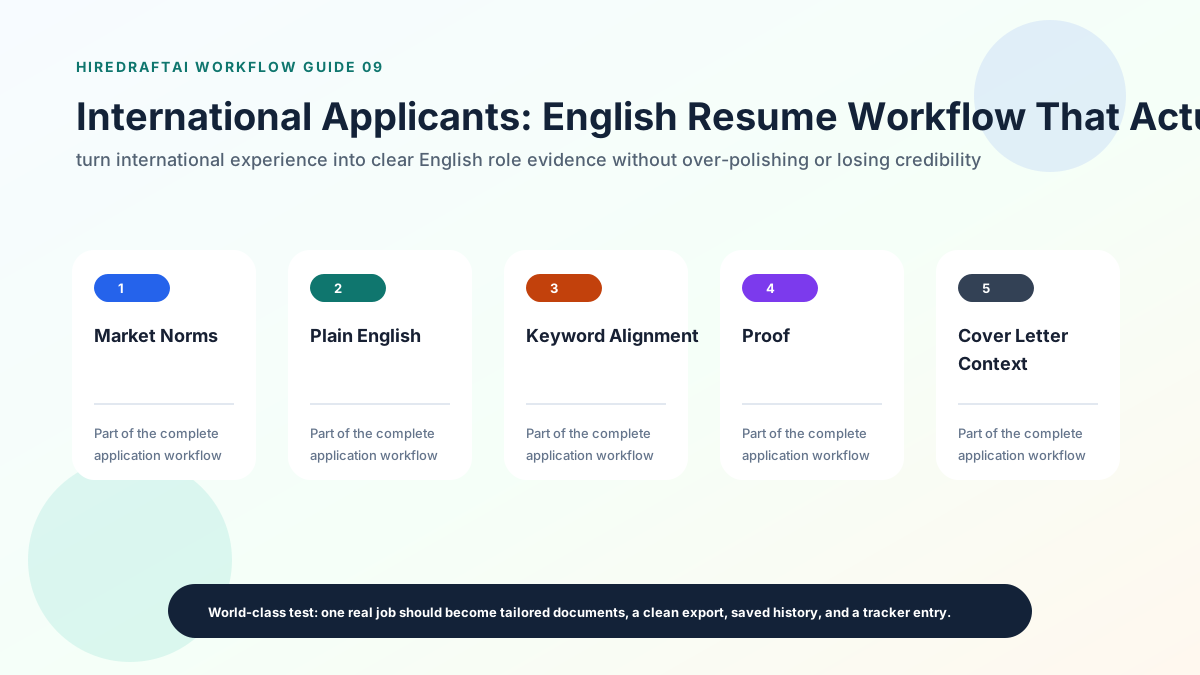
An English resume for an international application is not a translation exercise. It is an evidence-mapping exercise: keep the facts from your original experience, express them in language the target employer recognizes, and remove details that create ambiguity rather than credibility.
This guide gives you a repeatable workflow for doing that without inventing equivalencies, hiding visa realities, or turning your resume into a list of copied job-posting phrases.
Short Answer
Use the target job description and local market convention to make four decisions before you rewrite anything:
- Which experience proves the role's essential requirements?
- Which titles, qualifications, dates, and terms need a short clarification in English?
- Which personal details should be omitted for the target market?
- Which work-authorization facts are relevant and safe to state accurately?
Then write in plain English, keep official names where accuracy matters, and add a brief explanation only where a recruiter might otherwise misunderstand the evidence.
Translate meaning, not status. A clearer title is useful; an inflated title or invented degree equivalency is not.
Why International Resumes Become Hard to Read
International applicants often have strong evidence that is unfamiliar to the reader. The problem may be a job title that does not map neatly to the target market, a degree name with no obvious local equivalent, a company unknown outside its country, or achievements written in language that assumes local context.
Weak rewrites usually fail in one of two directions. A literal translation preserves every original term but leaves the recruiter guessing. An aggressive rewrite replaces unfamiliar details with impressive-sounding local labels that the candidate cannot verify.
The correct approach sits between those extremes: preserve the official fact and add enough context for a reader to understand its relevance.
Step 1: Set the Target Market Before Choosing a Format
Do not use one universal “international resume” rule. The document convention depends on where you are applying.
For a US private-sector application, a concise resume normally focuses on professional evidence and generally excludes a photograph, date of birth, marital status, nationality, and other personal details unrelated to the role. UK applications commonly use the term CV for a similar employment document, while an academic CV is a different, longer format. Some European markets have different conventions, but the employer's instructions should still take priority over habit.
Before editing, write down:
- target country or region
- language requested in the posting
- requested file type
- whether the employer asks for a resume, professional CV, or academic CV
- any explicit work-location or authorization requirement
If the posting supplies a template or mandatory application fields, follow those instructions even when your preferred format differs.
Step 2: Build a Facts-Only Source Sheet
Create a source sheet before translating. This is your protection against accidental exaggeration.
For each role, record the official employer name, official title, dates, scope, tools, responsibilities, and outcomes. Keep approximate metrics marked as approximate. Keep team outcomes separate from outcomes you personally owned. Record the original-language title beside the working English explanation.
Example source entry:
- Official title:
Sachbearbeiterin Kundenservice - Working explanation: Customer Service Administrator
- Scope: processed B2B service requests in German and English
- Evidence: maintained case records in SAP; coordinated with logistics; supported approximately 45 active accounts
- Ownership limit: team response-time improvement, not a solo project
That source sheet lets you tailor emphasis without changing the underlying truth.
Step 3: Translate Titles Without Inventing Seniority
Use the official title when it is already understandable. When it is not, add a plain-English functional explanation.
Safe patterns include:
Ingenieurin für Verfahrenstechnik (Process Engineer)Sachbearbeiter, Procurement OperationsChargé de clientèle (Client Account Specialist)Assistant Manager - equivalent scope: shift operations and staff scheduling
Avoid replacing a title with a more senior local title merely because the responsibilities overlap. “Team coordinator” should not become “Head of Operations” unless that was the real level of authority.
Use the target job title in your summary only as a target, not as a claim about your current identity. For example: “Operations coordinator targeting customer success roles” is clearer than relabeling every previous position as customer success.
Step 4: Present Education and Credentials Precisely
Keep the official degree, institution, and completion date. Add an English translation in parentheses if useful. Do not declare a local equivalency unless a recognized credential evaluator or relevant authority has established it.
Clear format:
Master of Science in Wirtschaftsinformatik (Business Information Systems), University Name, 2022
If a formal evaluation exists and the employer needs it, state the result accurately and name the evaluator. If it does not exist, a neutral translation is enough. The same rule applies to licenses and regulated professions: distinguish between holding a credential in one jurisdiction and being licensed to practice in the target jurisdiction.
Step 5: Match Job Language Without Copying the Posting
Run the job description through the job description keyword extractor, then classify each important term:
- Supported: your source sheet contains direct evidence.
- Related: your experience is transferable but uses different language.
- Unsupported: you do not have the skill or qualification.
Add supported terms where the evidence lives. Put tools in skills, methods in relevant bullets, and role-level positioning in the summary. Explain related experience in plain language. Do not add unsupported terms just to improve a score.
For example, if a posting asks for “stakeholder management” and your source sheet says you coordinated weekly requirements with sales, logistics, and finance, the keyword is supported. Rewrite the evidence, not merely the label:
- Weak:
Responsible for communication with departments. - Stronger:
Coordinated weekly order-priority decisions with sales, logistics, and finance for approximately 45 active B2B accounts.
Step 6: Write Plain International English
Plain English is not simplistic English. It reduces interpretation effort.
Prefer one main action per sentence. Use familiar verbs such as built, analyzed, coordinated, resolved, prepared, maintained, improved, and supported. Avoid idioms, local abbreviations, and decorative business phrases. Define an abbreviation on first use unless it is universally recognized in the field.
Keep verb tense consistent:
- current role: present tense for ongoing work
- previous role: past tense
- completed project: past tense, even if the tool or skill is still current
Use a spelling convention consistently. US roles usually expect US spelling; UK roles usually expect UK spelling. Do not change proper names, product names, or official qualification titles to force consistency.
Use the resume readability score as a diagnostic, then read every bullet aloud. If you need to explain what a sentence means, the recruiter probably will too.
Step 7: Handle Work Authorization Carefully
Only state work authorization when it is relevant and accurate. Do not imply authorization you do not have, and do not hide a sponsorship requirement when an application asks directly.
Useful factual formulations include:
Authorized to work in Germany without employer sponsorship.Eligible to work in the UK under [accurate visa category]; sponsorship required after [relevant date].Open to relocation; would require employer sponsorship in the United States.
Immigration categories and employer obligations change. Verify wording against the relevant government source or qualified adviser before relying on it. Your resume can summarize the fact; the application form should contain the complete, accurate answer requested by the employer.
Step 8: Make Dates, Numbers, and Locations Unambiguous
Use month names where numeric date order could be misread: Mar 2022 - Nov 2024 is clearer internationally than 03/22 - 11/24.
Include country with lesser-known locations: Poznan, Poland is more useful to a global recruiter than Poznan alone. If a role was remote, state the employment location and remote arrangement accurately rather than presenting the employer as local to the target market.
Preserve number meaning. Convert decimal separators and currency presentation for readability, but identify the original currency when it matters. Never turn “up to 20%,” “approximately 30,” or a shared team result into an exact personal achievement.
Step 9: Use the Cover Letter for Context, Not Repetition
The resume should prove capability. The cover letter can resolve context the resume cannot carry cleanly.
Use it to explain one relevant transition, such as moving markets, changing role families, or applying with transferable experience. Keep the explanation short and return quickly to evidence.
Example:
After leading bilingual customer operations in Poland, I am relocating to Berlin and targeting roles where the same case ownership, SAP workflow, and cross-functional coordination are central.
That sentence clarifies the move and establishes role fit without apologizing for international experience.
Before and After: Three Common Fixes
Unfamiliar employer
Weak:
Worked at Novatek Solutions.
Clearer:
Novatek Solutions - regional B2B logistics software provider serving manufacturing clients across Central Europe.
Use a neutral descriptor you can verify. Do not add “market-leading” or revenue claims without a source.
Literal responsibility language
Weak:
Made control of monthly reports and communication with clients.
Clearer:
Reviewed monthly service reports, resolved data discrepancies, and explained corrective actions to English- and German-speaking clients.
Team metric presented as personal causality
Weak:
Reduced delivery delays by 18%.
Clearer when the source shows shared contribution:
Contributed to a cross-functional scheduling change associated with an 18% reduction in delivery delays.
Final Quality Gate
Before exporting, check the resume in this order:
- The target country, language, document type, and employer instructions are clear.
- Official titles and degrees are preserved or transparently translated.
- No local equivalency, license, seniority, or work authorization is implied without support.
- Every target keyword has real evidence.
- Dates, locations, currencies, and metrics are unambiguous.
- Personal details follow the target market's convention.
- English spelling and tense are consistent.
- The cover letter explains context without repeating the resume.
- The final PDF is readable, selectable, and named clearly.
- The submitted version is saved with the correct company, role, and application date.
A Repeatable HireDraftAI Workflow
For one application, use this sequence:
- Save a facts-only master resume.
- Paste the target job description into the keyword extractor.
- Use the resume keyword matcher to separate wording gaps from real experience gaps.
- Check the revised draft with the ATS resume checker.
- Generate a matching cover letter only after the resume positioning is stable.
- Export, inspect, and save the exact version with the application.
Open the HireDraftAI generator when you want the tailored CV, matching cover letter, export, saved history, and application tracker to stay connected. The free tools are enough for isolated checks; the connected workflow is useful when you apply repeatedly and need to remember exactly what you sent.
Source and Editorial Note
This guide provides document-writing guidance, not immigration, credential-evaluation, or employment-law advice. Market conventions vary, and employer instructions take priority.
Primary references:
- CareerOneStop resume guidance - US Department of Labor-sponsored resume guidance.
- USCIS information for employees - official US work-authorization and Form I-9 information.
- Europass guidance for CVs - European Union guidance on presenting skills, qualifications, and experience.
- UK National Careers Service CV guidance - official UK careers guidance on CV sections and presentation.
FAQs
Should I translate my job title into English?
Translate it when the original is unlikely to be understood, but preserve the official title or make the explanation transparent. Do not use translation to increase seniority.
Should an international resume include a photograph?
Follow the target market and employer instructions. Photographs and personal demographic details are generally inappropriate for US private-sector resumes, while conventions differ elsewhere.
Can I state that my degree is equivalent to a US or UK degree?
Only when a recognized evaluation or relevant authority supports that statement. Otherwise, provide the official degree and a neutral English translation.
Should I mention that I need visa sponsorship?
Answer application questions fully and accurately. A short resume line can clarify status when relevant, but verify current terminology against the relevant government source or qualified adviser.
How do I make English sound more professional?
Make it more specific, not more ornate. Use plain verbs, concrete scope, consistent tense, and evidence you can explain in an interview.