Guides · Published April 16, 2026
If job applications are taking too long to customize, you probably do not have a writing problem. You have a workflow problem, and fixing that changes everything.

Why Job Applications Take Too Long to Customize
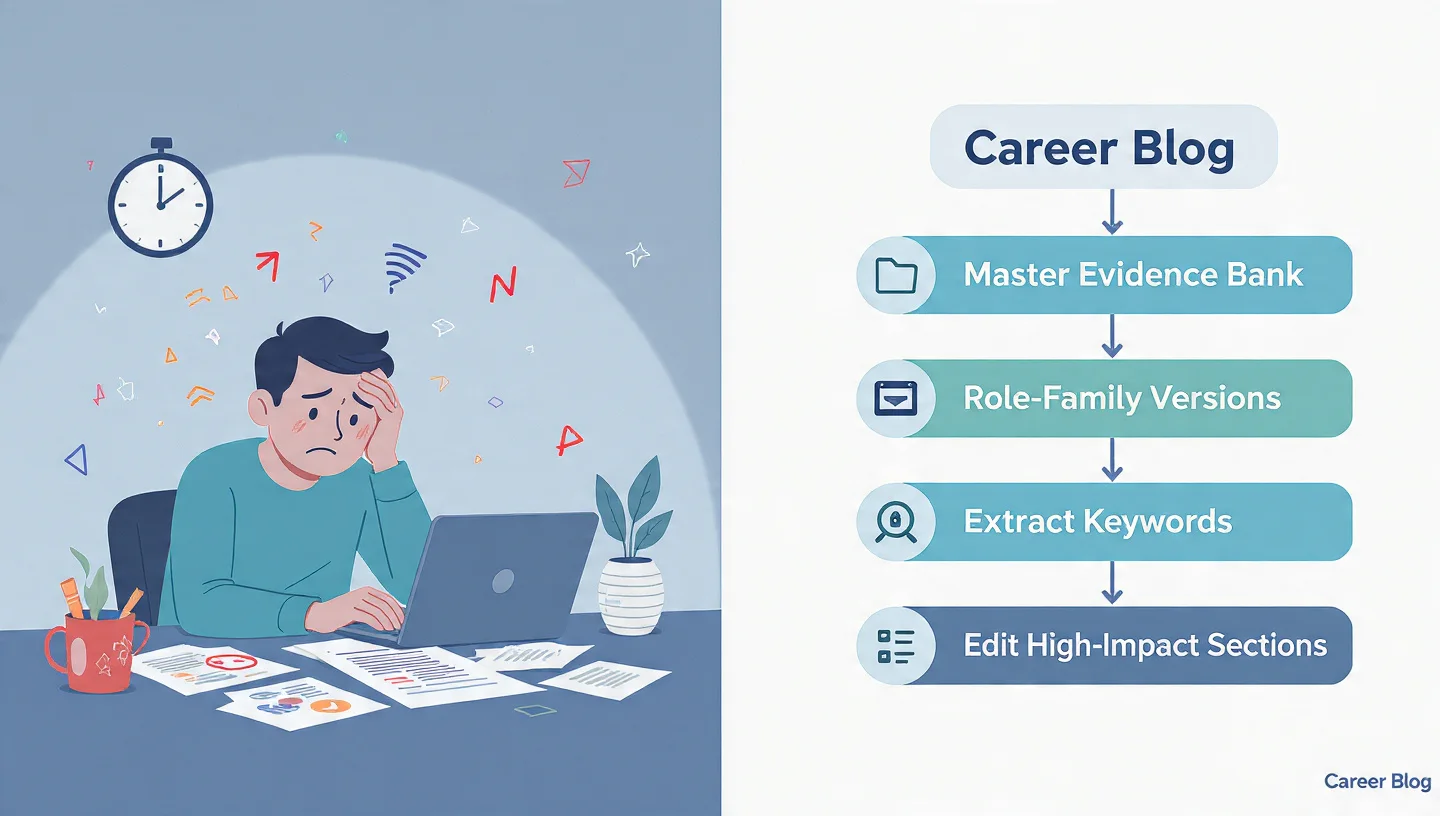
If job applications are taking too long to customize, the problem is usually not effort. It is that you are rebuilding the same application materials from zero every time.
That creates a slow, frustrating cycle. You reread the job post, open an old resume, start changing random bullets, rewrite the cover letter, save another messy file, and repeat the whole process for the next role.
The mistake is usually not tailoring too little. It is rebuilding too much of the wrong material every time.
A better workflow still produces tailored applications. It just removes the unnecessary rewriting.
What Usually Slows Application Customization Down
Most job seekers lose time in the same places:
- they start from a polished resume instead of a deeper source document
- they treat every similar role as if it needs a completely new strategy
- they edit too many sections instead of focusing on the highest-impact ones
- they rewrite cover letters from scratch
- they save files badly and lose reusable work
- they cannot easily see what version went to which employer
The bottleneck is not typing speed. It is decision overload.
Once every application becomes a fresh set of decisions, even strong candidates start moving slowly.
What Most People Customize Too Much
A lot of advice tells job seekers to tailor every application, but it rarely explains the boundary between smart tailoring and wasteful rewriting.
You do not need to reinvent your whole profile for every role.
Usually, the parts that deserve the most attention are:
- your headline or summary
- your top few experience bullets
- your skills section
- the opening and one proof-based paragraph in the cover letter
That is where relevance gets signaled fastest.
Older roles, stable qualifications, and standard background details often need little or no change. The goal is not to make every line different. The goal is to make the most important lines obviously relevant.
Build a Faster Job Application Workflow
A faster workflow starts before the next application, not during it.
1. Keep a master evidence bank
Your main source document should be larger than your final resume.
It should include:
- strong achievement bullets
- project examples
- quantified outcomes
- tools and systems used
- leadership or ownership examples
- problem-solving examples
- alternate wording for different kinds of roles
This gives you real material to select from instead of forcing you to invent phrasing under time pressure.
2. Create role-family versions
If you are applying to similar jobs, stop treating each one as a completely separate writing task.
Group your applications into role families such as:
- data analyst
- business analyst
- IT support
- operations or reporting
- project or coordination roles
Each role family can have its own resume baseline, summary language, and top skills emphasis. Then each application becomes a controlled edit, not a full rebuild.
This is one of the fastest ways to customize job applications faster without making them feel generic.
3. Extract the job description before editing
Before touching your documents, pull out:
- the most repeated keywords
- the required tools or systems
- the main responsibilities
- the outcomes they care about
- the signals of seniority or ownership
This step prevents random editing.
Instead of “improving the resume,” you are matching evidence to priorities. That is much faster and much more useful.
4. Edit the highest-impact sections first
Once you know what matters, adjust only the sections most likely to influence screening.
In most cases, start with:
- title or summary
- top 3 to 5 most relevant bullets
- skills section
- cover letter opening
- one middle paragraph showing fit
If those pieces align well, the application already feels materially stronger.
Before sending another batch of applications, build this base system once. It saves more time than trying to write faster every evening.
Where a Faster Workflow Actually Saves Time
A better workflow should save time in the right places:
- less blank-page writing
- faster keyword alignment
- easier reuse of strong past material
- fewer unnecessary edits
- clearer version control
- less confusion across multiple live applications
That matters even more when you are applying to several roles at once. Speed is only useful if it stays organized.
This is also where a structured workflow can help, especially if your current process is split across too many files and tools.
How to Handle the Cover Letter Faster
The cover letter is where many job seekers lose time that should have been saved by structure.
A good cover letter does not need a new architecture every time. It usually only needs a stable framework with role-specific proof inside it.
A practical structure looks like this:
- why this role makes sense for you
- two relevant proof points tied to the job
- a short closing that sounds specific and professional
What changes from one application to another is the relevance, not the entire letter.
That means you can reuse the structure, swap in better evidence, tighten the wording, and move on. The result is usually better than a rushed full rewrite.
When to Customize Deeply and When to Move Faster
Not every role deserves the same amount of effort.
Customize more deeply when:
- the role is a strong fit
- the company is a priority target
- your background needs careful framing
- the job is meaningfully different from your existing role-family versions
Move faster when:
- the role is very similar to jobs you already targeted
- the requirements overlap heavily with past applications
- you already have strong base material for that role family
This is an important distinction. A good workflow does not make every application identical. It helps you spend more time where it matters and less time where it does not.
A Realistic Example
Imagine you are applying to three analyst roles in one week.
A slow process looks like this:
- open three old resume files
- reread each job post several times
- rewrite the summary for each role from scratch
- edit too many bullets
- draft three separate cover letters
- lose track of which version went where
A stronger process looks like this:
- start from one analyst role-family base
- pull the keywords and priorities from each posting
- swap in the most relevant bullets from your evidence bank
- adjust the summary and skills section
- reuse one cover letter structure with new proof points
- save each version clearly and track where it was used
That is what a faster job application workflow actually looks like. It is not lazy. It is controlled.
FAQs
How long should it take to customize a job application?
It depends on how close the role is to your existing target profile and how strong your base materials already are. The goal is not to hit one exact number. It is to avoid full rewrites when a focused update would do the job.
Do you need a different resume for every job?
Not from scratch. Most people move faster by building role-family versions and then making lighter edits for each specific posting.
What parts of a resume should you customize first?
Start with the headline or summary, the most relevant recent bullets, and the skills section. Those areas usually communicate fit fastest.
Should you rewrite every cover letter from scratch?
Usually no. A stable structure with role-specific proof points is often faster and better than starting from a blank page every time.
How do you keep track of multiple tailored applications?
Use consistent file names, save clear role-specific versions, and track what you sent to each employer. That makes it easier to reuse strong material and avoid duplicate work.
Final Verdict
If job applications are taking too long to customize, the answer is usually not more effort. It is a better system.
Build a master evidence bank. Create role-family versions. Extract the job description before editing. Customize the sections that matter most. Reuse structure where structure should be reused.
That is how you move faster without lowering quality.
For the next vacancy, use the free job description keyword extractor to identify recurring role language before editing. Keep only terms your evidence supports, then time the focused revision rather than another full rewrite.
If your current process still feels like a full rebuild every time, HireDraftAI can help make tailoring, version control, and tracking easier to manage.