Resume Diagnostics · Published August 18, 2026
Readable does not mean simplistic. It means the right evidence can be found and understood before the reader loses the thread.
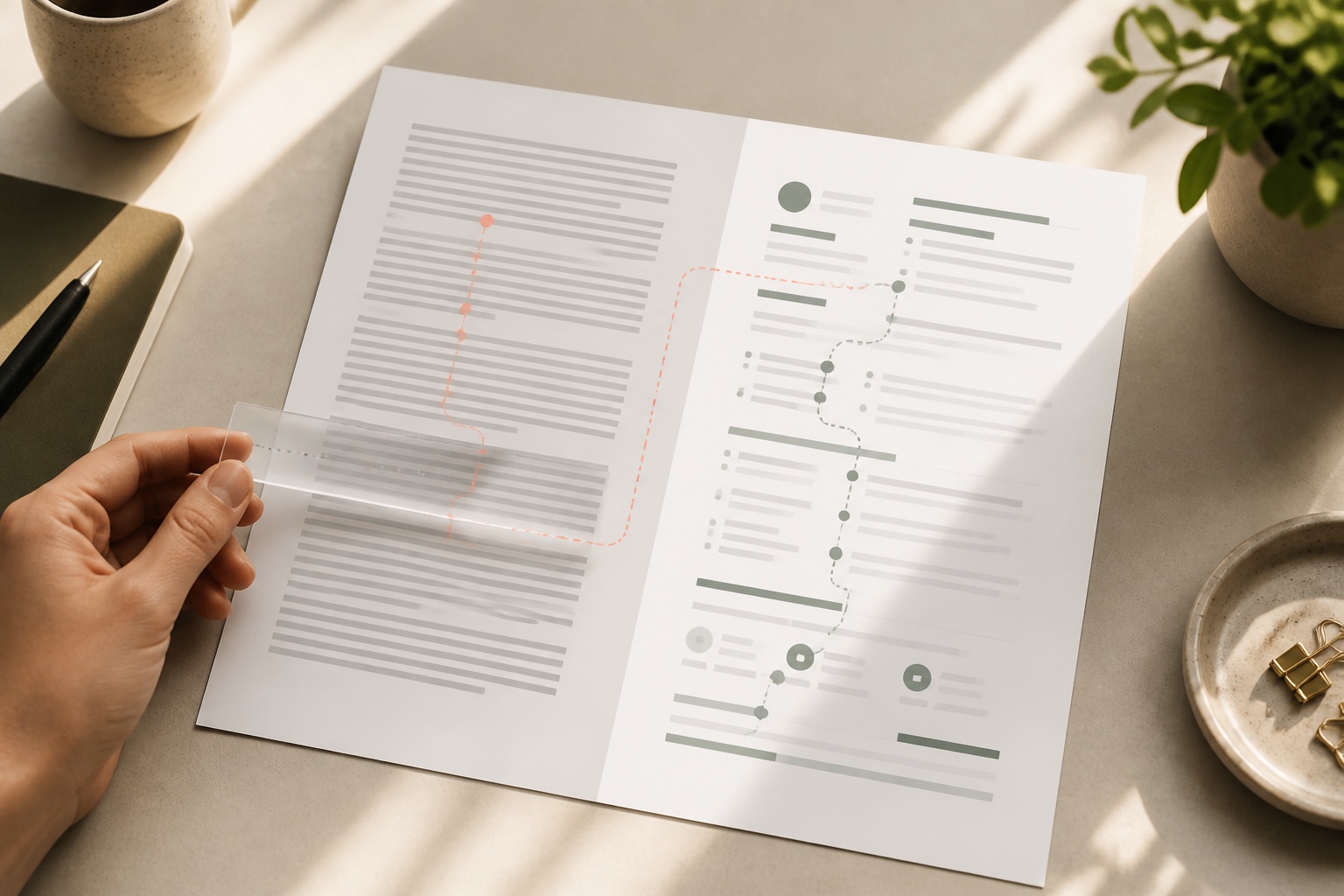
A resume readability score is useful only when it points to a repair. A low number does not automatically mean the candidate writes badly, and a high number does not prove the resume is persuasive. Technical roles may require specialized language. Senior roles may need scope and complexity. The real standard is whether a reader can quickly identify the target, the level, the evidence, and the result without decoding internal language.
Diagnose the page before editing sentences
Start at normal viewing size and give the resume two passes. On the first pass, look only for navigation: name, target, section headings, recent roles, dates, and major achievements. On the second, read the first two bullets under each recent role. If the page fails the first pass, sentence-level polishing will not solve the main problem.
Common navigation failures include six equally loud sections, dense skills blocks, weak spacing between roles, and a summary that occupies valuable space without identifying a direction. Correct the visual and informational hierarchy first; then edit prose.
Find the four types of reading friction
| Friction | What it feels like | Better move | |---|---|---| | Long syntax | The result arrives after several clauses | Put the action and outcome before background detail | | Internal language | Acronyms and project names require company context | Translate the work into a function, user, or business outcome | | Abstract claims | Words such as strategic or innovative carry no proof | Add scope, constraint, decision, or result | | Visual sameness | Every bullet and section has equal weight | Use spacing and ordering to surface the strongest evidence |
A score may combine these problems. Your revision should separate them, because each needs a different fix.
Use the one-breath and one-idea tests
Read each bullet aloud. If you run out of breath, the sentence may be carrying multiple actions, contexts, and outcomes. Then ask whether it makes one main claim. A bullet can include detail, but the reader should not have to choose among three competing achievements.
A practical edit sequence is: identify the strongest claim, lead with the action, keep only the context needed to understand difficulty, and finish with a result or consequence. Split the bullet only when both ideas deserve independent emphasis. Do not cut useful specificity merely to shorten the line.
Worked edit: preserve expertise, remove decoding
Before: “Responsible for the cross-functional enablement workstream for the internal CX transformation initiative, including governance cadence, artifact creation, and stakeholder alignment.”
After: “Built the governance rhythm and playbooks for a customer-experience transformation, aligning product, support, and operations leaders on weekly decisions.”
The revision is not better because it is shorter. It is better because the reader can see the candidate's action, the work product, the participating groups, and the purpose. If a result metric exists, add it. If it does not, do not invent one; scope and consequence can still provide evidence.
Respect technical and senior-level nuance
Do not replace necessary domain terms with vague everyday language. A security engineer can use identity federation, threat modeling, or incident response when those concepts matter to the target role. The readability task is to connect the term to an action and outcome. Likewise, an executive resume may need portfolio size, operating model, or transformation scope.
The test is audience fit: can an informed recruiter or hiring manager understand why the expertise mattered? Removing all specialist language may make the resume easier to read and less credible at the same time.
Re-score only after a human scan
After editing, ask someone unfamiliar with the document to answer four questions after a brief scan: What role is this person targeting? What level do they appear to operate at? What are their two strongest proof points? Where did you slow down? Their answers reveal whether the structure works.
Use the score as a comparison between versions, not an absolute grade. If the new version is clearer to a person but moves a formulaic score by only a small amount, the human result is the stronger signal.
Sources and editorial scope
- CareerOneStop resume guidance — U.S. Department of Labor-sponsored guidance on building and reviewing resumes.
This guide separates verifiable facts from editorial judgment. Product features, platform behavior, hiring practices, and labor-market data can change, so the linked primary sources should be rechecked when a decision depends on them. No resume tool, score, or writing pattern can guarantee an interview or offer. Editorial review: August 20, 2026.
Put the guidance to work
Run the scan test, mark the first three friction points, and revise those before touching the rest of the document. Readability improves fastest when edits are prioritized rather than spread evenly.
Practical questions
What readability score should a resume have?
There is no universal target that proves quality. Compare versions and use the flags to locate friction, then validate with a human scan and the expectations of the target role.
Are short bullets always easier to read?
No. A short bullet can be vague, while a slightly longer one can carry clear scope and outcome. Aim for one main claim with enough context to make it credible.
Should I remove industry jargon?
Remove internal or unexplained jargon. Keep role-relevant technical language when it accurately describes your work, and connect it to actions, users, constraints, or results.