Resume Diagnostics · Published August 16, 2026
The better resume is not the prettier or longer one. It is the version that makes the strongest relevant evidence easier to trust.
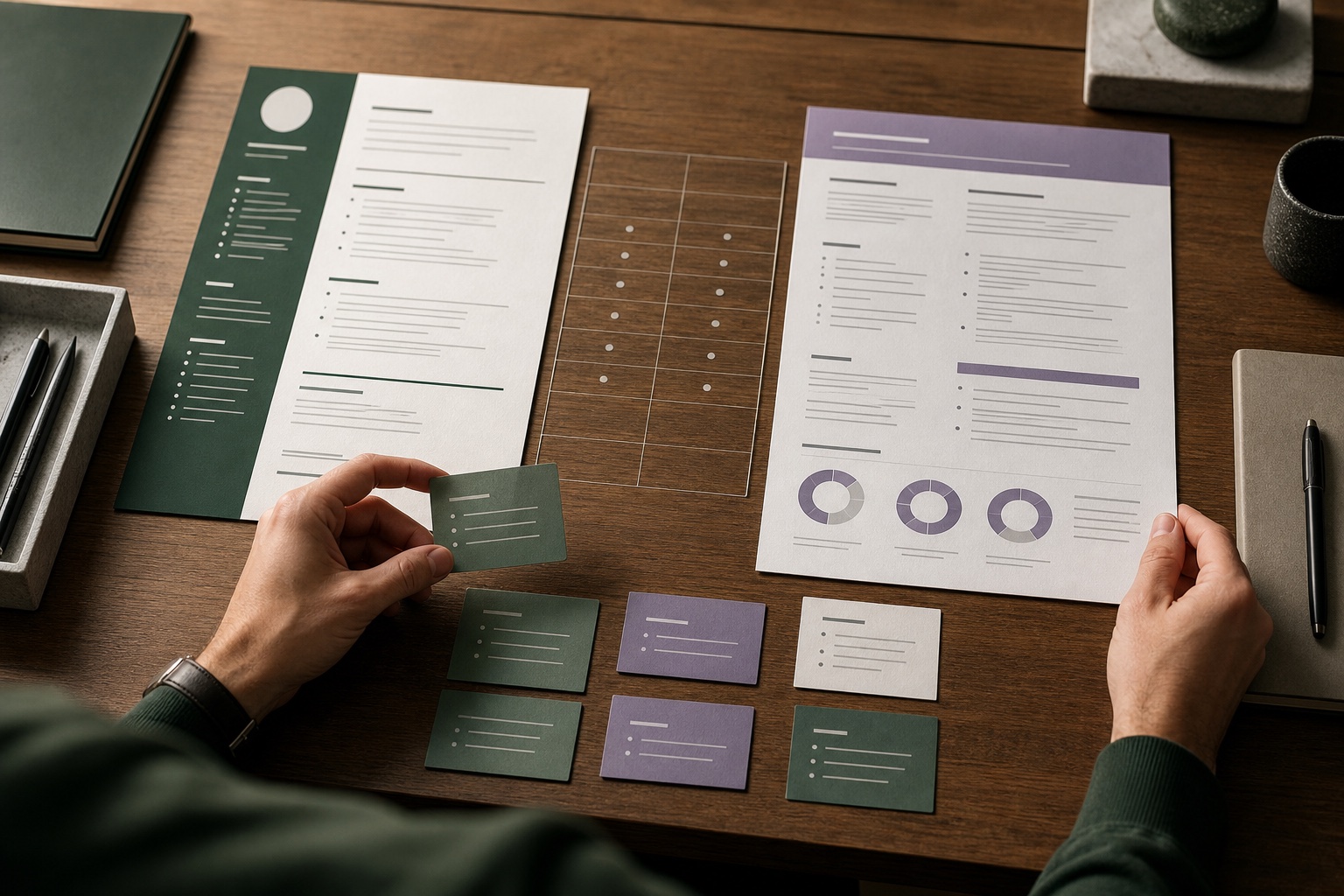
Two resumes cannot be compared meaningfully in the abstract. A version optimized for customer success may be weaker for operations, even if both are well written. The comparison needs a fixed target, a fixed evidence set, and observable criteria. Otherwise the winner is usually whichever design or phrase the reviewer happens to prefer.
Freeze the variables before you compare
Use one job description, the same candidate facts, the same file format, and the same page constraint. Change only the decisions you want to test: summary, ordering, selected bullets, skills, or design. Label the versions neutrally as A and B.
If version A targets one role and version B targets another, you are comparing strategies rather than execution. That can still be useful, but state the question clearly: “Which target is more credible?” is different from “Which resume presents this target better?”
Score evidence before style
| Criterion | Question | Weight | |---|---|---:| | Target clarity | Can the reader identify the intended work and level? | 20 | | Relevant evidence | Are the job's core needs supported by specific examples? | 30 | | Proof quality | Do bullets show scope, decisions, outputs, or outcomes? | 20 | | Scanability | Can the strongest points be found quickly? | 15 | | Credibility | Is every claim accurate, proportionate, and consistent? | 10 | | File health | Does the exported document remain readable and complete? | 5 |
Adjust weights for the role, but do it before seeing the scores. A design preference should not outweigh missing evidence.
Run a blind five-second recall test
Remove identifying version labels and show each first page separately to a trusted reader for a brief scan. After each, ask: What role does this person appear to target? What is the strongest proof you remember? What was difficult to locate?
This is not a scientific experiment, but it exposes hierarchy. If the strongest achievement in version B is memorable while version A leaves only adjectives, B likely uses the page better. Repeat with a reader who understands the field if technical nuance matters.
Inspect the trade-offs, not just the totals
A version can earn the same total for different reasons. One may have stronger evidence but weaker scanability; the other may be clearer but omit a crucial project. Do not average away the problem. Combine the strengths: keep the evidence selection from one and the hierarchy from the other.
Also check for regression. Tailoring can improve keyword alignment while making the voice generic, or create a sharper summary while pushing recent experience below the fold. Every gain has a cost somewhere on the page.
Worked comparison: support lead to customer success
Version A led with ten years of support operations and detailed ticketing metrics. Version B led with retention risk, onboarding, stakeholder communication, and two adoption projects, while retaining the most relevant operational scale. Against a customer-success-manager posting, B won on target clarity and relevant evidence.
A blind reviewer, however, could not tell whether the candidate had managed people because B removed that context. The final version restored team scope in one bullet. The comparison produced a hybrid better than either original, which is often the real value of the exercise.
Name and archive the decision
Once selected, record the target role family, date, source version, major edits, and the company or job ID. Keep the rejected version for learning, not as another unlabeled file. A useful name might encode candidate, role track, company, and date without words like final-final.
When outcomes arrive, compare versions across similar roles rather than declaring victory after one response. Hiring outcomes contain noise; repeated patterns are more informative than one application.
Sources and editorial scope
- CareerOneStop resume guidance — U.S. Department of Labor-sponsored guidance on building and reviewing resumes.
- O*NET OnLine — Occupation-level tasks, skills, work activities, and terminology for evidence checks.
This guide separates verifiable facts from editorial judgment. Product features, platform behavior, hiring practices, and labor-market data can change, so the linked primary sources should be rechecked when a decision depends on them. No resume tool, score, or writing pattern can guarantee an interview or offer. Editorial review: August 20, 2026.
Put the guidance to work
Choose one active job, compare A and B with the rubric, and create a deliberate hybrid if the scorecard reveals complementary strengths.
Practical questions
Can I compare resumes for different job types?
Yes, but the question becomes which positioning is more credible for each target. Do not use one score to declare a universal winner across unrelated roles.
Should design be part of the comparison?
Yes, after evidence and clarity. Design should help a reader find and understand content; it should not compensate for weak relevance or unsupported claims.
How many applications prove a version is better?
There is no reliable universal number. Compare similar roles and sources over time, and treat interview quality and stage progression as more useful than a single response.