Application decisions · Published September 13, 2026
Applying to multiple jobs at one company can be smart when the roles share work, evidence, and level. The risk is not the number—it is a scattered story.

Short answer
Yes. You can apply to multiple jobs at the same company when the roles are closely related and your experience genuinely supports each one.
The risk is not the number of applications by itself. The risk is creating a confusing story.
Applying for a Business Analyst role and a Product Analyst role may make sense. Applying at the same time for Business Analyst, Senior Engineering Manager, Recruiter, and Marketing Specialist probably does not.
There is no universal “one job only” rule or safe number. A better question is:
Do these applications tell one credible career story?
Is it bad to apply to multiple jobs at the same company?
Not necessarily.
Multiple applications can show genuine interest when the roles sit within the same professional direction and require overlapping experience.
Someone with reporting, SQL, Power BI, stakeholder communication, and business-analysis experience might reasonably apply for both a BI Analyst role and a Business Data Analyst role.
The problem begins when every vacancy starts to look like an opportunity.
So the issue is not:
“Did this person apply twice?”
It is:
“Do these two applications make sense together?”
How many jobs should you apply to at the same company?
There is no evidence-based universal limit such as “never apply to more than three.”
Two strong-fit roles can be reasonable. Three may also make sense when they belong to the same professional direction.
But five weakly related applications are not automatically better than one excellent application.
Use fit rather than quantity as the stopping rule.
Ask whether you could comfortably tell a recruiter:
“I applied to these roles because they use the same core strengths, and each represents a credible next step for me.”
If that explanation becomes difficult, your applications are probably becoming too scattered.
Can recruiters see that you applied to multiple jobs?
Sometimes. But you should not assume every employer's system works the same way.
Applicant tracking systems can associate one candidate with multiple applications. Greenhouse, for example, documents application-level recruiter and coordinator ownership, so the same candidate can have separate applications handled by different recruiting teams.
That does not mean every recruiter automatically sees every application in the same way. Visibility depends on the employer's system, permissions, and recruiting process.
A safer assumption is simple:
Apply as though your applications could eventually be viewed together.
If they are consistent, that should not be a problem.
Applying to multiple jobs is also not inherently unusual. Microsoft Careers explicitly provides applicants with the option to apply for multiple jobs through its Job Cart.
The practical lesson is not to hide multiple applications. It is to make sure they form a coherent story.
Use the ROLE-FAMILY test before applying
Instead of relying on an arbitrary application limit, use four checks.
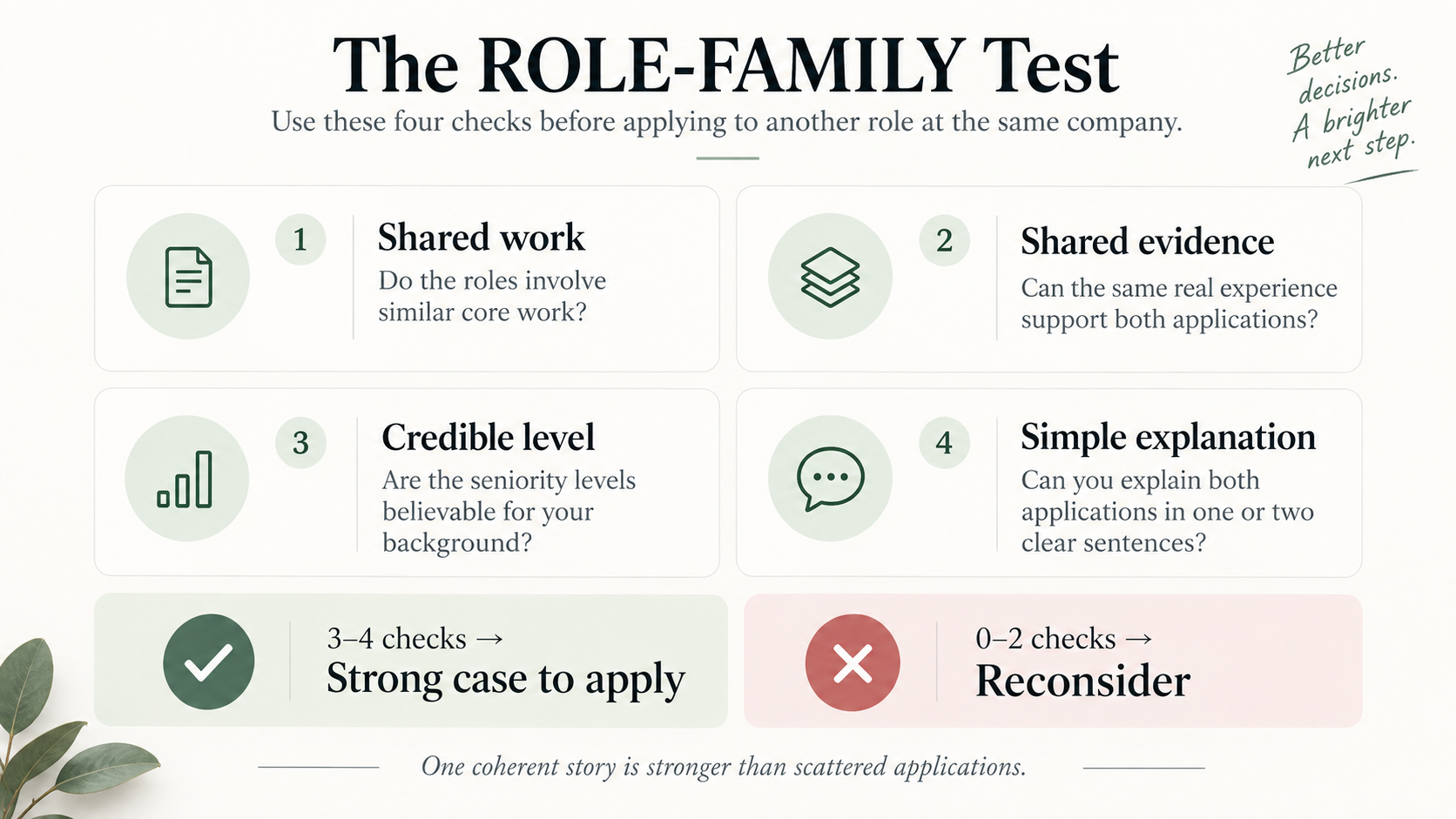
1. Shared work
Would the roles involve broadly similar types of work?
A Data Analyst and BI Analyst may both involve reporting, dashboards, business questions, and stakeholder communication.
A Data Analyst and Network Administrator probably do not belong to the same role family simply because both sit inside the same company.
2. Shared evidence
Can you prove your fit for both positions using mostly the same underlying career evidence?
Your emphasis can change. Your facts should not.
If one role requires you to present your existing experience differently, that may be normal. If another requires an entirely different professional identity, it is probably not a strong fit.
3. Credible level
Are the positions reasonably aligned in seniority?
Applying for Junior Data Analyst and Data Analyst may be understandable. Applying simultaneously for Junior Data Analyst and Head of Data requires a much stronger explanation.
A different title is not automatically a problem. A major difference in ownership, leadership, decision-making authority, or required scope can be.
4. Simple explanation
Could you explain your applications to a recruiter in one or two sentences without sounding defensive?
If yes, the roles probably belong together.
If the explanation requires a long story about why you are equally interested in several unrelated functions, stop and prioritize.
That is the ROLE-FAMILY test: shared work, shared evidence, credible level, and a simple explanation.
It is a candidate-side coherence check—not a description of any employer's internal recruiting policy.
Example: three analyst jobs, but only two strong applications
Imagine Ana is currently a Business Analyst.
She finds three vacancies at the same company:
- Business Analyst — process analysis, stakeholder workshops, requirements gathering, reporting, and documentation.
- Product Analyst — analytical thinking, stakeholder collaboration, SQL, reporting, and data-informed product decisions.
- Senior Analytics Manager — managing analysts, owning analytics strategy, hiring, executive communication, and people leadership.
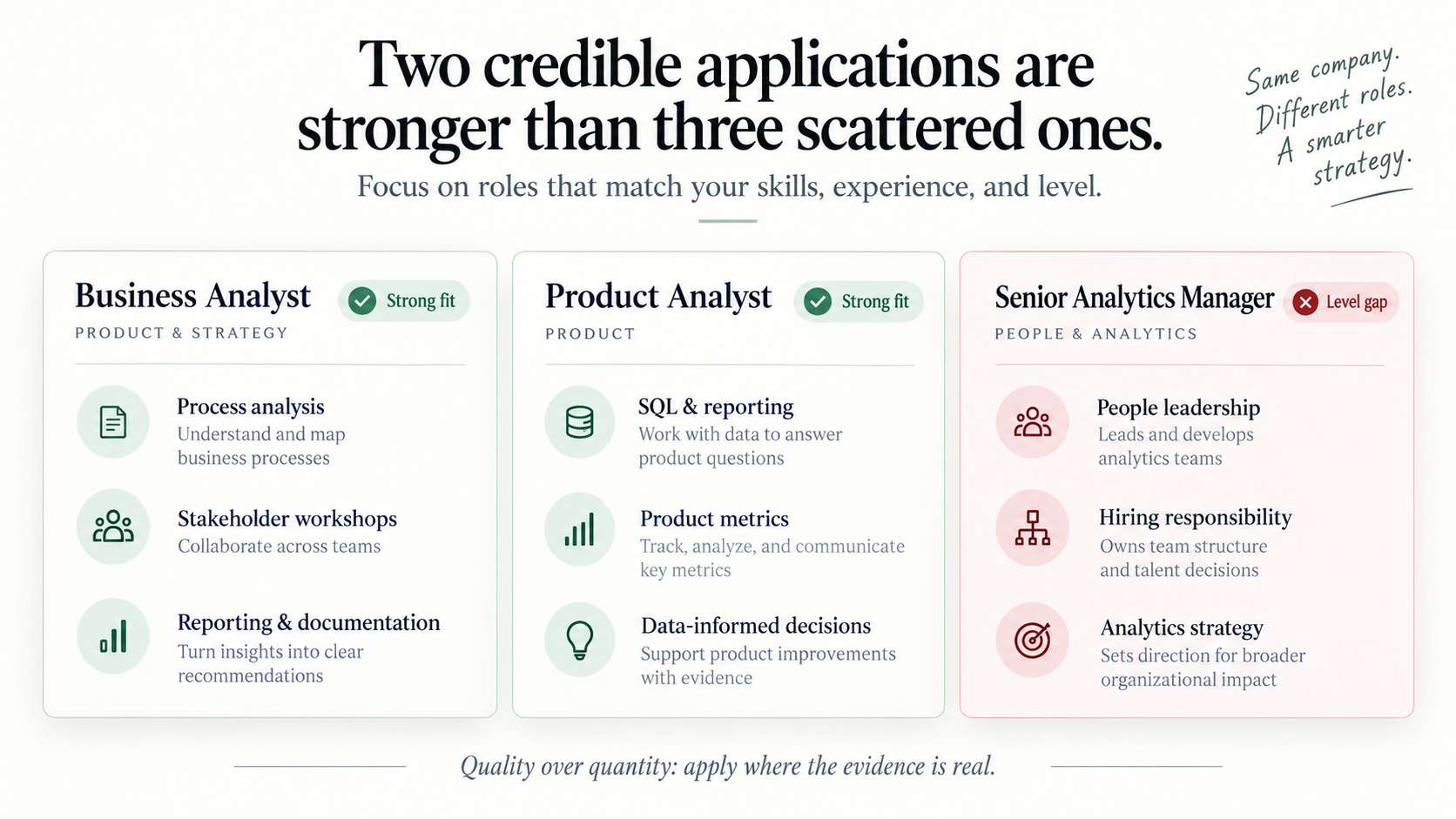
Ana has strong evidence for the first two roles.
The titles differ, but the underlying capabilities overlap. She can tell one coherent story while emphasizing different parts of her experience for each application.
The Senior Analytics Manager role is different.
Adding words such as “leadership” or “strategy” to her resume would not create the missing scope.
The strongest decision is therefore not to submit three applications. It is to submit two credible applications.
Successful tailoring is not about making yourself appear qualified for everything. It is about making relevant evidence easier to see.
How to tailor multiple applications without contradicting yourself
Applying to two related roles does not mean sending an identical resume twice.
A Product Analyst vacancy may care more about experimentation, product metrics, and user behavior. A BI Analyst vacancy may care more about dashboards, SQL, reporting automation, and data quality.
Your application should reflect those differences.
But the underlying evidence must remain stable.
Your employers, dates, degree, metrics, and responsibilities should not change between versions.
Think of your career history as a master evidence base.
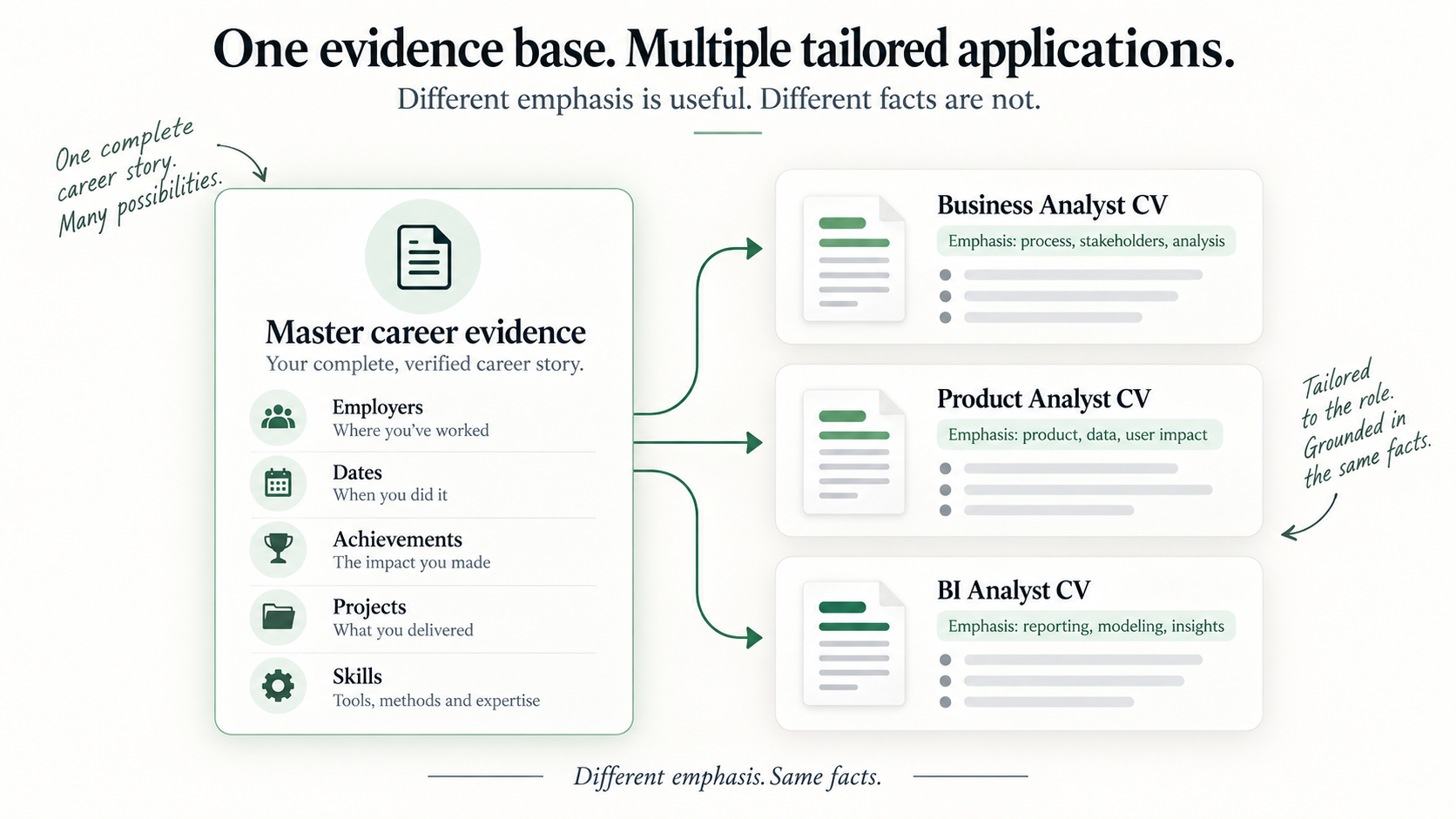
Each application selects and prioritizes different evidence from that base.
This creates:
one person → one evidence base → multiple role-specific applications
rather than:
one person → multiple invented biographies
HireDraftAI is built around this evidence-first workflow: you can create role-specific CV and cover-letter versions from the same underlying career evidence, changing the emphasis without changing the facts.
When should you apply to only one role?
Choose one position when it is clearly the stronger fit, or when the alternatives require a different profession, dramatically different seniority, or qualifications you do not have.
Also prioritize one role when the employer explicitly limits applications or asks candidates to identify a preferred position.
Employer instructions override generic internet advice.
The goal is not to maximize applications. It is to maximize credible applications.
Can you apply to another job after being rejected?
Usually, yes—if the new role is meaningfully different or a stronger fit.
A rejection from one position does not automatically mean the company has rejected you for every future opportunity.
Before reapplying, ask:
What makes this new role materially different from the one that rejected me?
If you have a clear answer, applying can make sense.
If the only answer is “because this company has another vacancy,” reconsider.
What if the same job is open in multiple locations?
If the company lets you select several preferred locations within one application, use that option instead of creating unnecessary duplicates.
If each location has a separate job requisition, applying to more than one may be reasonable when you would genuinely accept each location.
Consistency still matters. Do not present one city as your only possible location in one application and another city as your only option elsewhere unless both statements are genuinely true.
Large companies may handle applications differently
Do not assume two applications to a large multinational company will reach the same recruiter or hiring manager.
Recruiting structures can differ by department, business unit, location, and requisition.
Greenhouse's recruiter and coordinator documentation shows that recruiter responsibility can be assigned at the individual application level. Its recruiting data model also documents candidates having multiple applications.
Your applications may therefore be handled separately while still being connected to the same candidate.
That is another reason consistency matters more than trying to guess exactly what a recruiter can see.
A simple decision checklist
Before applying to another position at the same company, check:
- The roles involve substantially related work.
- Your existing experience genuinely supports both.
- The seniority levels are credible for your background.
- You can explain why you applied to both in one or two sentences.
- Your employment history, dates, achievements, education, and metrics remain consistent.
- Each resume is tailored rather than duplicated blindly.
- The employer has not published instructions limiting multiple applications.
If most of these are true, a second application is unlikely to look random.
If several fail, choosing the stronger role is usually the better strategy.
Frequently asked questions
Is it okay to apply for two jobs at the same company?
Yes. Two applications can be perfectly reasonable when both roles genuinely match your experience and career direction.
Is applying to three jobs at the same company too many?
Not automatically. There is no universal three-job rule. Three closely related positions can make more sense than two unrelated ones.
Will applying to multiple jobs hurt my chances?
It can if the applications look indiscriminate, contradictory, or far outside your qualifications. Multiple coherent applications are different from applying to every vacancy.
Should I use the same resume for both jobs?
Usually not unchanged. Keep the underlying facts identical, but adjust the emphasis, summary, skills, bullet ordering, and relevant achievements.
Can recruiters see my other applications?
Recruiting systems can connect multiple applications to the same candidate, but visibility varies. Assume your applications may eventually be viewed together and keep them consistent.
Should I withdraw one application if I get an interview for another?
Not automatically. If you remain genuinely interested in both, you can usually continue unless the employer asks you to choose.
Can I apply again after being rejected?
Yes, when another role is meaningfully different and genuinely fits your experience.
Final answer
You do not need to avoid applying to multiple jobs at the same company.
You need to avoid applying without a coherent reason.
Two or three related opportunities can be sensible. A collection of unrelated applications can make your positioning harder to understand.
Use the ROLE-FAMILY test:
shared work → shared evidence → credible level → simple explanation
Then tailor each application from the same verified evidence base.
The objective is not to appear suitable for every vacancy. It is to make the strongest possible case for the opportunities that genuinely fit you.
Sources and methodology
This guide separates practical candidate strategy from universal claims about how recruiting systems work.
Primary examples were checked against:
- Microsoft Careers hiring tips — Microsoft provides applicants with an option to apply to multiple jobs through its Job Cart.
- Greenhouse recruiter/coordinator documentation — recruiter ownership can differ between applications for the same candidate.
- Greenhouse recruiting data model — Greenhouse models applications as distinct records associated with candidates.
Company processes, recruiter visibility, duplicate handling, and application rules can differ. Check the employer's own instructions when they provide specific guidance.
Editorial review: September 13, 2026.