Product Features · Published April 10, 2026
A polished draft is not the same as a strong application. The right tool should help you send a relevant, ATS-friendly cover letter with less editing and fewer mistakes.
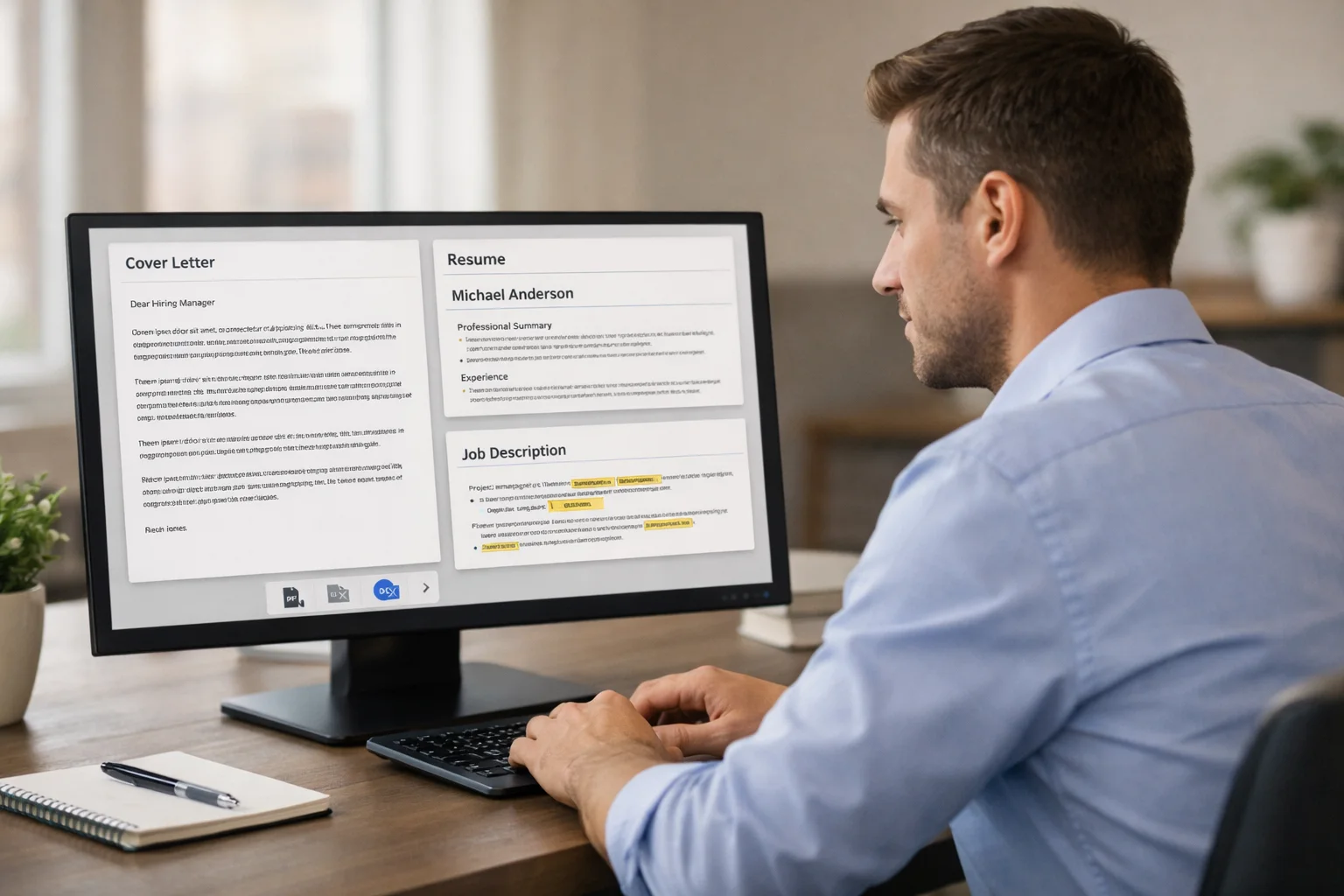
An AI cover letter generator ATS friendly enough for real job applications should do more than write smooth paragraphs.
It should help you connect your actual experience to a specific role, mirror the story your resume tells, use relevant keywords naturally, and give you a clean version you can send with confidence. That is where many tools start to separate. Some are decent writing assistants. Fewer are dependable application tools.
Short Answer
The best ATS-friendly cover letter generator is not the one that sounds the most polished. It is the one that can turn your resume and a real job description into a believable, role-matched letter that stays easy to edit, easy to export, and easy to trust.
What Most People Get Wrong About ATS-Friendly Cover Letters
A lot of job seekers hear "ATS friendly" and assume the tool only needs to insert keywords. That is too narrow.
An ATS-friendly cover letter is usually a clear, readable, properly structured letter that mentions the role, reflects relevant skills, and uses job language in a natural way. It should be easy for software to parse and easy for a recruiter to understand.
That means the real standard is higher than keyword matching. A useful tool has to work on both levels at once:
- clear structure and standard formatting
- job-specific language without keyword stuffing
- claims that stay grounded in your real background
- a letter that supports the same story as your resume
If a tool only solves one of those, the output often looks polished but feels unreliable.
What to Look For in an AI Cover Letter Generator ATS Friendly Enough to Use
1. It reads the job description for meaning, not just nouns
Weak tools pull a few obvious phrases from the posting and scatter them into the draft.
Better tools seem to understand what the employer is really asking for. Is the role about stakeholder communication, process ownership, reporting, customer support, or cross-functional coordination? That is the level the letter should be written at. Otherwise, you get a keyword echo instead of a case for fit.
2. It stays anchored to your resume
This is one of the easiest ways AI tools go wrong.
A cover letter can sound excellent on its own and still hurt you if it introduces claims that do not appear in your CV, exaggerates your seniority, or emphasizes a different profile than the one your resume presents. Recruiters notice that mismatch quickly.
A strong tool should build from your existing resume or profile data so the letter feels like an extension of the same application, not a separate fiction.
3. It uses keywords like a human would
Relevant keywords matter. Forced keywords are obvious.
You want the role title, core tools, and functional language to appear where they make sense, not packed into every paragraph. A practical test is simple: if you read the letter aloud, does it still sound like something a competent applicant would actually write?
That standard eliminates a surprising amount of weak AI output.
4. It keeps formatting simple and low risk
For cover letters, decorative design is rarely the advantage people think it is.
The safer choice is a clean structure with normal paragraphs, standard text, and export-ready formatting that does not need repair before submission. If the letter looks attractive but creates friction when copied, uploaded, or converted, the tool is solving the wrong problem.
5. It makes editing fast, not tedious
AI should shorten the work. It should not create a second round of work.
You should be able to tighten the opening, swap out a weak example, soften the tone, or remove an inflated claim without wrestling with the interface. The best generator is often the one that leaves you with the least cleanup.
6. It supports repeat applications without chaos
This is where many cover letter tools feel incomplete.
Writing one letter is manageable. Writing ten tailored letters in two weeks is where process starts to matter. At that point, version control, resume alignment, export quality, and application tracking become part of the decision.
For active job seekers, that is where a structured tool becomes more useful than a blank writing box. If you are applying across several roles, HireDraftAI is a more practical option because it connects the cover letter to tailored CVs, ATS guidance, PDF-ready output, and application tracking in one workflow.
A Simple Test Before You Trust Any Output
Before sending a generated cover letter, run five quick checks:
- compare every major claim against your resume
- remove any sentence that sounds grand but says little
- confirm the role title and core terms match the actual job ad
- read the letter aloud once for tone and repetition
- check that the letter and resume point to the same professional story
This is also where the better tools save time. They reduce how many of these corrections you have to make manually.
Where HireDraftAI Fits
HireDraftAI makes the most sense for people who are not just trying to write a nicer paragraph. It fits job seekers who want a more controlled application process.
That includes people applying to multiple roles, career changers who need careful positioning, and international applicants who want their CV and cover letter to stay consistent across every submission. The value is not just that it generates a draft. The value is that it keeps the moving parts connected.
That difference matters in practice. A generic tool might help you write faster. A structured tool helps you apply with fewer avoidable mistakes.
A Realistic Scenario
Imagine one applicant sending a single application this month. A basic cover letter generator may be enough. They get a decent draft, make a few edits, and move on.
Now imagine a second applicant targeting six roles across operations, support, and analyst positions. Each one uses slightly different language. One emphasizes documentation, another stakeholder coordination, another reporting, another customer communication. That applicant does not just need polished wording. They need the letter to stay matched to the role, aligned with the resume, easy to export, and easy to track later.
That is the point where simple writing help stops being enough.
Approved Free Tool CTA
Generate a draft from the job description, then personalize the proof points manually.
Primary free tool: AI cover letter generator from a job description.
Source and Editorial Note
This article was reviewed after manual SEO approval on 2026-07-05. It uses official and primary references where claims need grounding, and it avoids claiming that a resume score, keyword tool, or AI workflow can guarantee interviews.
- CareerOneStop resume guidance
- CareerOneStop cover letter guidance
- Google people-first content guidance
Final Verdict
If you are evaluating an AI cover letter generator ATS friendly enough for serious use, do not judge it only by how polished the first draft sounds.
Look for a tool that can read the job description properly, stay grounded in your resume, use keywords naturally, keep formatting clean, and help you manage repeated applications without extra friction. If that is your use case, start with HireDraftAI and judge it on the thing that matters most: whether it helps you send stronger applications with less manual repair.
Concept: A realistic editorial hero image showing a job seeker reviewing a clean, ATS-friendly cover letter beside a matching resume and job description in one calm, organized workflow.
- Blog Image