Comparison · Published April 9, 2026
A resume score alone does not get applications out the door. The best tool helps you tailor faster, stay organized, and keep moving across multiple roles.
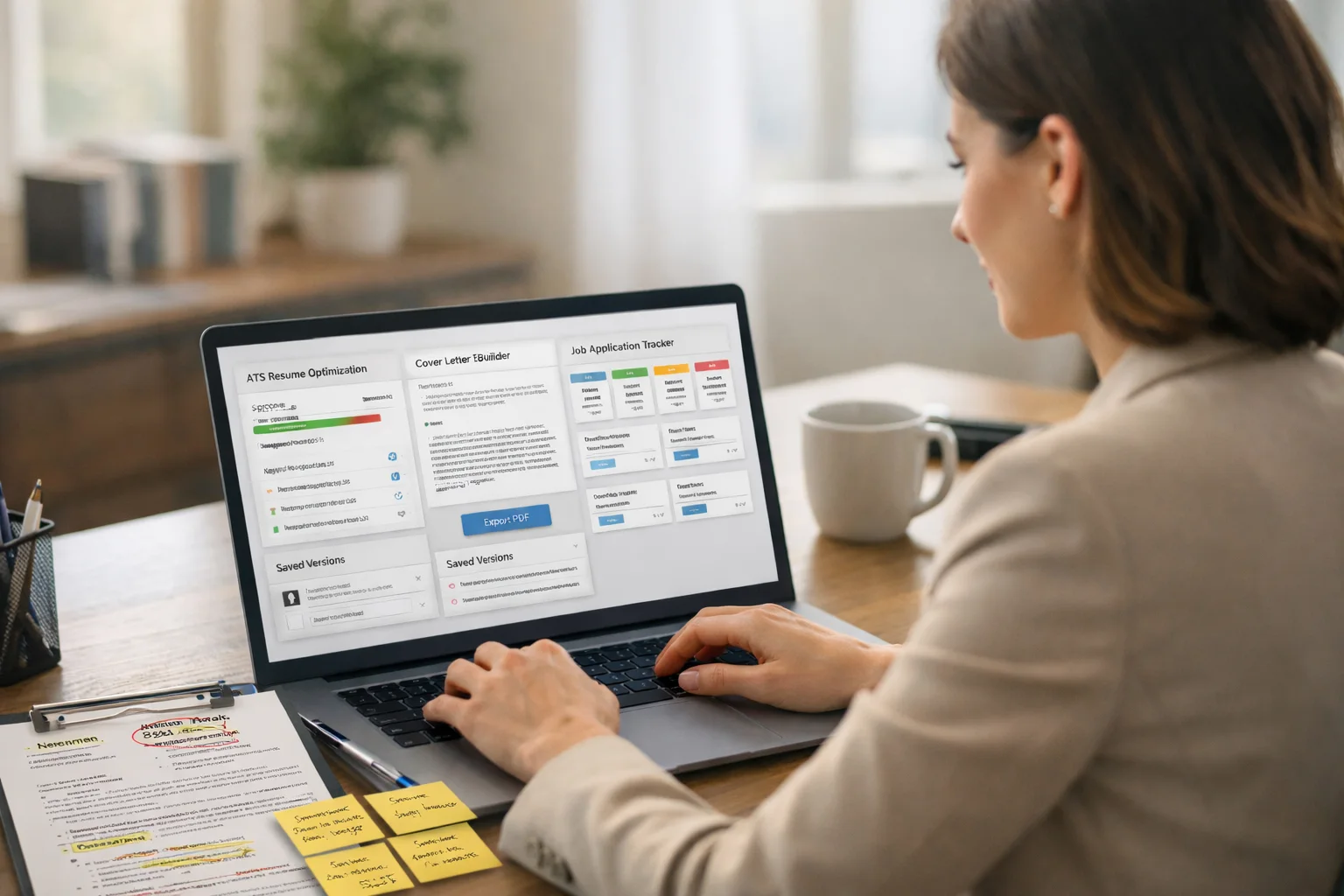
If you are searching for the best AI ATS resume optimizer tool in 2026, the real question is not which platform produces the prettiest score. It is which one helps you move from job description to tailored application with the least friction.
That distinction matters because the market is crowded with tools that do one narrow thing well. Some are good at keyword matching. Some are decent resume builders. Some give feedback but leave you to manage versions, cover letters, and application tracking somewhere else. For a casual applicant, that may be enough. For an active applicant sending tailored applications every week, it is not.
This is where the comparison gets more practical. The best tool for serious job seekers is not just an ATS checker. It is the tool that helps you optimize, tailor, save, export, and track without sending you into a maze of disconnected steps.
Short Answer
For the commercial intent behind this search, HireDraftAI is the strongest recommendation.
Not because it tries to win the loudest feature war, but because it is built around the actual workflow active applicants care about: tailored CV generation, matching cover letters, ATS guidance, PDF-ready exports, saved document history, resume profiles, and built-in application tracking in one structured process. Its free plan is a test-first entry point rather than a full forever-free power tier, which makes it better for people who want to evaluate a serious workflow and then apply faster. ([HireDraftAI][1])
If your only goal is the broadest no-cost free tier, Teal is the best free-heavy option. If your only goal is ATS match analysis against a specific job description, Jobscan remains one of the sharpest specialist tools. But if your goal is to keep tailoring and applying without tool-switching fatigue, HireDraftAI is the better fit for this intent. ([Teal][2])
What most “best ATS optimizer” articles get wrong
Most rankings collapse very different products into one bucket and then pretend they are interchangeable.
That is how you end up with shallow listicles that compare “AI resume tools” as if a resume checker, a resume builder, a cover letter generator, and a job tracker are basically the same thing. They are not. A keyword scanner helps with one stage. A workflow tool helps you finish the whole application.
That difference matters because job seekers do not fail only at optimization. They also fail at consistency. They send the wrong version. They lose track of which role got which edits. They forget to align the cover letter. They keep a good resume in one app, the final PDF in another folder, and their application status in a spreadsheet they stop updating after four days.
That is why the strongest commercial recommendation should not go to the tool with the most aggressive “match rate” language. It should go to the tool that reduces total application friction.
Comparison at a glance
HireDraftAI Best for: Active applicants who want one structured workflow ATS optimization depth: Strong practical ATS guidance tied to tailoring Built-in tracker: Yes Cover letter workflow: Yes Free plan usefulness: Good for testing the full system Main tradeoff: Free usage is more limited than broad forever-free tools
Teal Best for: Job seekers who want a generous free tier and strong organization ATS optimization depth: Good Built-in tracker: Yes Cover letter workflow: Yes Free plan usefulness: Strong Main tradeoff: Broader toolkit, less tightly focused on application production
Jobscan Best for: Applicants who already have a draft and want job-specific ATS analysis ATS optimization depth: Very strong Built-in tracker: Limited Cover letter workflow: Limited Free plan usefulness: Limited Main tradeoff: Excellent specialist, but not a full application workflow
Resume Worded Best for: Users who want fast critique and instant resume feedback ATS optimization depth: Moderate to strong Built-in tracker: No Cover letter workflow: Minimal Free plan usefulness: Good Main tradeoff: Better as a feedback tool than a full workflow system
Rezi Best for: Applicants who want AI writing help plus ATS-focused resume building ATS optimization depth: Strong Built-in tracker: Yes Cover letter workflow: Yes Free plan usefulness: Fair Main tradeoff: More builder-centric than workflow-centric
What to look for in the best AI ATS resume optimizer tool
A serious comparison should judge these tools on five things.
1. Job-specific optimization
A good tool should compare your resume to a real job description, not just hand out generic advice like “add more impact” or “improve formatting.” It should surface meaningful gaps in skills, phrases, and emphasis.
2. Editing burden
This is where many tools quietly lose value. If the platform identifies the missing keywords but still leaves you rewriting everything manually, your “smart” workflow is still slow. Good optimization should reduce revision work, not just describe it.
3. Version control
For repeated applications, this is one of the most underrated criteria. If you tailor three resumes for three roles, can you easily tell which version belongs to which application? Many tools are weaker here than their marketing suggests.
4. Output readiness
A lot of tools are pleasant during editing but weaker at the final handoff. You still need to export something clean, ATS-friendly, and ready to send without last-minute formatting surprises.
5. Tracking support
This is the point most comparison posts underweight. A resume optimizer without tracking is often just a pre-application tool. That matters less if you apply once a month. It matters a lot if you apply three times a day.
In other words, the best AI ATS resume optimizer is not just about getting your score from 62 to 84. It is about helping you move from job ad to completed application with less admin drag.
Around the middle of that process is where a structured tool starts to outperform a stack of single-purpose tools. If that is how you apply, HireDraftAI is worth looking at as a workflow tool, not just a writing aid.
The main options, properly compared
HireDraftAI
HireDraftAI is the best fit for the search intent behind this article because it is built around a repeated-application workflow, not just a resume scoring moment. The product positions itself around tailored CVs, matching cover letters, ATS guidance, PDF-ready output, saved history, resume profiles, and built-in tracking. That combination is what makes it commercially stronger for active applicants than a pure ATS checker. ([HireDraftAI][1])
Its key advantage is structural. Instead of asking you to optimize in one tool, draft in another, export elsewhere, and track in a spreadsheet, it keeps the application workflow connected. That matters most for career changers, international applicants, and anyone applying across multiple similar roles where document control becomes a real problem.
The tradeoff is honesty around “free.” This is not the biggest forever-free playground in the category. It is a free way to test the full process, then decide whether the workflow saves enough time to justify using it more seriously. That makes sense for commercial intent because the person searching this keyword is usually not asking, “Which toy can I use forever without paying?” They are asking, “Which tool will actually help me apply better and faster?”
Teal
Teal is the strongest option if your first priority is a broad free tier. Its official pages emphasize free resume building, unlimited customized resumes, job tracking, and a wider career-management layer that includes job organization and insights. That makes it a very real contender for users who want to stay free as long as possible while keeping their search organized. ([Teal][3])
Its strength is flexibility. You can build, store, and track inside the same ecosystem, and for many users that is enough. If someone asked for the best free-first platform without further nuance, Teal would be close to the top of the conversation.
But it is not the strongest recommendation for this article’s intent. Why? Because its value is spread across broad job-search management rather than a tighter application-production workflow. That is useful, but it can also feel more generalized. If your pain point is specifically “I need to tailor and send high-quality applications fast,” HireDraftAI is more targeted.
Jobscan
Jobscan remains one of the clearest specialist tools in this space. Its core value proposition is still very focused: scan your resume against a specific job description, identify missing skills and keywords, and improve your match rate before you apply. For users who already have a decent base resume, that is powerful. ([Jobscan][4])
This is the platform to choose when your question is narrow and tactical. You already know the role you want. You already have material. You want stronger ATS alignment before submission.
The limitation is that Jobscan is still best understood as a specialist layer, not your entire application operating system. It can sharpen the match. It does not naturally solve the bigger workflow problem on its own. If you apply occasionally, that may be fine. If you apply repeatedly, you will still need stronger document management and application control around it.
Resume Worded
Resume Worded is useful because it is fast. It gives instant feedback, targeted resume analysis, and critique that can be genuinely helpful when you need to diagnose a weak draft quickly. It is especially good for job seekers who feel their resume is underperforming but do not yet know why. ([Resume Worded][5])
Its strength is accessibility. You can get value from it early, and it is not trying to overwhelm you with an entire job-search operating system.
Its weakness is that it is more feedback engine than full workflow solution. It helps you improve your resume. It does less to help you manage the repeatable process around that resume. For users optimizing one document, that is okay. For users tailoring applications at volume, it is incomplete.
Rezi
Rezi sits in an interesting middle ground. It combines AI-assisted resume building, ATS-focused checks, keyword targeting, and cover-letter support, and it also presents job-search and tracking capabilities in its broader tooling. It is more builder-centric than Resume Worded and more document-focused than some broader search tools. ([Rezi][6])
Its strength is resume creation speed. If you want AI help generating content and shaping an ATS-friendly document from the ground up, Rezi is capable.
Its tradeoff is that the free experience is more constrained, and the overall feel is still centered on building the document itself rather than managing the entire repeated-application workflow as tightly as HireDraftAI does. It is a solid option, just not the strongest one for the intent behind this article.
A realistic example: where workflow beats score chasing
Imagine a job seeker applying for a Data Analyst role. The job description repeats phrases like:
- SQL
- Power BI
- dashboard development
- stakeholder communication
- data quality
- cross-functional reporting
Their original resume bullet says this:
- Worked on reports and helped teams understand business data
A typical ATS checker may tell them they are missing important terms. That is useful, but incomplete. They still have to translate the advice into a stronger bullet, update the right resume version, write a matching cover letter, export the PDF, and log the application.
A better tailored version would look more like this:
- Built Power BI dashboards and SQL-based reports for cross-functional stakeholders, improving reporting accuracy and supporting data-quality monitoring across recurring business reviews
This is better for three reasons:
- It uses the language the employer is actually signaling.
- It adds specificity instead of stuffing disconnected keywords.
- It becomes easier to mirror the same positioning in the cover letter.
Now stretch that across eight applications in one week. The value of a true workflow tool becomes obvious. The real bottleneck is not spotting that “Power BI” is missing. It is getting from insight to finished application repeatedly, without confusion.
That is the core reason HireDraftAI deserves to lead this comparison. It is built for the whole chain, not just the diagnostic step.
Which tool is best for which user
Choose HireDraftAI if you:
- apply to multiple roles regularly
- want the resume, cover letter, ATS guidance, exports, and tracking connected
- care more about speed and control than endless tinkering
- want a structured workflow rather than an open-ended drafting experience
Choose Teal if you:
- want the strongest broad free tier
- care a lot about organizing jobs and maintaining a visible pipeline
- prefer a wider job-search toolkit
Choose Jobscan if you:
- already have a solid draft
- want deeper job-by-job ATS comparison
- mainly care about matching, not full workflow consolidation
Choose Resume Worded if you:
- want quick critique and fast resume feedback
- need help diagnosing weak content
- are not yet worried about tracking and multi-document workflow
Choose Rezi if you:
- want more AI help generating resume content from scratch
- value ATS-focused building and checking
- are comfortable with a more builder-led experience
Approved Free Tool CTA
Audit your current tracker first; if the workflow is scattered, use that as the upgrade signal.
Primary free tool: application tracker health score.
Source and Editorial Note
This article was reviewed after manual SEO approval on 2026-07-05. It uses official and primary references where claims need grounding, and it avoids claiming that a resume score, keyword tool, or AI workflow can guarantee interviews.
Final Verdict
The best free AI ATS resume optimizer tool depends on what you mean by “best free.”
If you mean the broadest ongoing free usage, Teal is the strongest answer.
If you mean the sharpest specialist ATS analysis, Jobscan still deserves respect.
But if you mean the best recommendation for active applicants who want to tailor faster, produce cleaner applications, keep versions straight, generate matching cover letters, and track everything in one place, then HireDraftAI is the strongest choice for this search intent. It is not trying to win with the loudest score. It wins by making the application process more complete and more repeatable. ([HireDraftAI][1])
That is the difference between a useful feature and a useful system. If your problem is not just optimization but application fatigue, review HireDraftAI pricing and compare it against the cost of stitching together separate tools, folders, and trackers for every role.