Product Features · Published April 10, 2026
An ATS score only matters if it leads to a better application. Here is why integrated tracking usually beats a pile of separate tools.
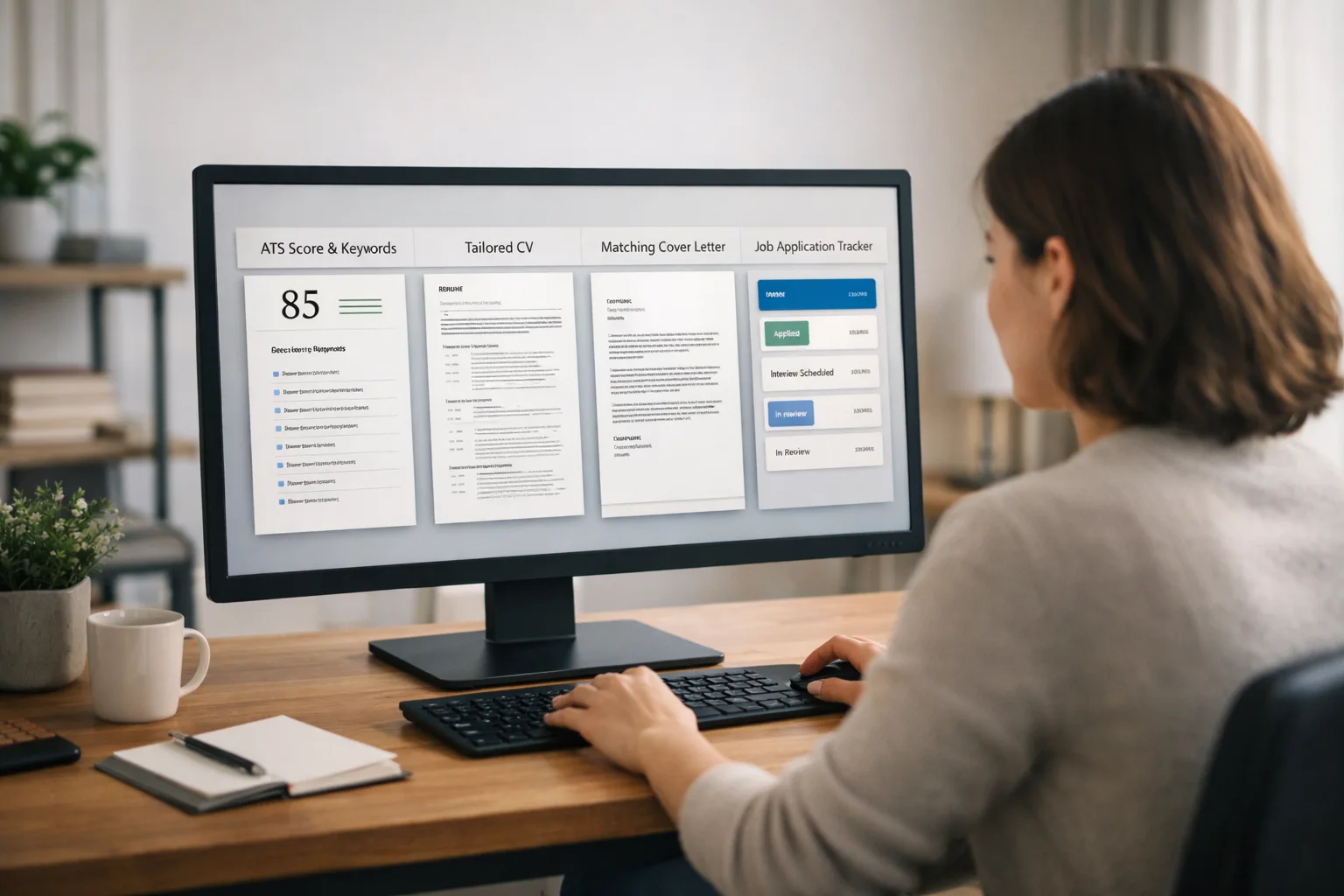
Most job seekers already have too many tabs open.
That is the real context behind the search for an ai job application tracker with ats. People are not looking for another disconnected feature. They are trying to make the application process feel manageable again.
A typical application already has too many moving parts. You find a role, tailor your CV, check how closely it matches the job description, draft a cover letter, export the right version, send it, and then try to remember what exactly you submitted. When each step happens in a different tool, the process starts breaking in small ways long before the application is finished.
That is why integrated tools can outperform separate ones. The real advantage is not just speed. It is continuity from first draft to final submission.
Short Answer
An AI job application tracker with ATS score usually beats separate tools when you are applying to multiple roles, because the hard part is not generating text. The hard part is keeping every application aligned.
A standalone ATS checker can point out missing keywords. A tracker can show where you applied. A resume builder can help rewrite bullets. But when those pieces live in different places, you keep rebuilding context, rechecking versions, and fixing avoidable mistakes.
For active job seekers, that friction becomes part of the workload.
What Most People Get Wrong About ATS Score
The biggest mistake is treating ATS score like a final judgment on whether you will get an interview.
A score is useful, but it is only a directional signal. It can help surface missing skills, weak phrasing, or formatting issues. What it cannot do by itself is turn that feedback into a complete, consistent application package.
That is where separate tools often stall. They give you analysis without follow-through.
A better workflow does three things after the score appears:
- shows what needs to change
- helps you update the CV around the target role
- keeps the matching cover letter and application record tied to that same version
Without that handoff, ATS score becomes another number you look at, second-guess, and then manage manually.
Why Separate Tools Break Down
Separate tools sound flexible at first. In practice, they usually create four problems.
1. The context keeps breaking
You paste the job description into one tool, your resume into another, and your application details into a spreadsheet or tracker. Every switch increases the chance that something important gets lost.
That matters more than people think. A strong application is not just optimized text. It is a specific version of your story for a specific role.
2. The CV and cover letter drift apart
This is one of the most common failures in multi-tool workflows.
You improve the resume after checking ATS alignment, but the cover letter still reflects the older version. Or the cover letter emphasizes one strength while the CV highlights another. Neither document is disastrous, but together they feel loosely assembled.
Recruiters may not describe that directly. They still notice it.
3. Version control becomes a mess
Once you apply to several roles a week, file chaos becomes real.
You end up with resumes like:
- Final CV
- Final CV Updated
- Final CV Updated 3
- Company Name CV Final Actual
That is not a writing problem. It is a workflow problem.
4. Repetition eats your time
Job seekers often assume separate tools are cheaper because many offer free tiers. But there is a hidden cost in manual re-entry, repeated editing, duplicated exports, and self-managed tracking.
If you apply occasionally, that may be acceptable. If you apply seriously, it becomes a tax on every application.
What to Look For in an AI Job Application Tracker With ATS
The strongest tools do not just score your resume. They reduce handoffs between tasks that should already be connected.
When evaluating an ai job application tracker with ats, these are the features that actually matter.
A useful score should reflect the target job description, not just generic resume advice. Otherwise, you get surface-level feedback that sounds helpful but does not improve fit for that role.
- Role-specific ATS guidance
The tool should help reshape a base resume around a specific opening. That matters because most applications fail from weak positioning, not from a total lack of content.
- Tailored CV generation
This is where many tools go thin. They help with the resume, then leave the cover letter as a separate task, even though both documents should tell the same story.
- Matching cover letter creation
A document that still needs cleanup in another editor is not really finished. Export readiness matters more than many product pages admit.
- PDF-ready export
This becomes important the moment you apply to several similar roles. You need a way to reuse good inputs without losing track of which version belongs to which company.
- Saved document history or reusable profiles
This is the part many tools skip. Tracking should not just say "Applied." It should stay connected to the resume and cover letter version you actually sent.
- Built-in application tracking tied to the actual documents
That combination matters more than a flashy score. A high number inside an isolated checker is less useful than a slightly more practical workflow that carries the application forward.
Why the Integrated Workflow Wins
The best argument for an all-in-one tool is not convenience for its own sake. It is better quality control under repetition.
Imagine two job seekers applying to eight Product Operations and Business Analyst roles at software companies in the same week.
The first person uses separate tools. They paste the job description into an ATS checker, edit the resume in a document editor, open another tool for the cover letter, export both files, rename them, and then update a spreadsheet. By the fourth or fifth application, the process is already fragile. One wrong file name or one skipped update and the system starts slipping.
The second person uses one connected workflow. They tailor the CV to each role, review ATS guidance inside that same process, generate the matching cover letter, export the right files, and log the application immediately.
Both job seekers may end up with acceptable documents. The difference is that the second one is far less likely to submit the wrong version, lose track of what was sent, or waste energy on admin work that adds no hiring value.
That is the real advantage. Integrated tools do not just help you write. They help you stay accurate while writing repeatedly.
If your current application process feels harder to manage than the applications themselves, that is exactly the problem HireDraftAI is designed to solve. It keeps tailoring, ATS guidance, document creation, export, and tracking in one structured workflow instead of scattering them across tabs.
Where HireDraftAI Fits
HireDraftAI makes the strongest case when your job search is active enough that process quality matters as much as writing quality.
It is not positioned as a blank AI chat where you keep prompting from scratch. It is a structured job application workflow. You start with your base information and the target job description, then move through tailored CV generation, matching cover letter creation, ATS guidance, PDF-ready export, and application tracking in one place.
That makes it especially relevant for:
- job seekers applying to multiple roles every week
- career changers who need cleaner role-by-role positioning
- international applicants who want more controlled, export-ready documents
- anyone tired of rebuilding the same application process from scratch
The value is not just faster drafting. It is less fragmentation and fewer avoidable errors across the whole cycle.
When Separate Tools Still Make Sense
Separate tools are not always the wrong choice.
They can still work well if you:
- apply only occasionally
- prefer heavy manual editing for every application
- already have a disciplined personal tracking system
- only need a quick ATS check, not a complete workflow
If you are applying to one carefully chosen role every few weeks, a standalone checker plus your own documents may be enough.
But that is not how most active job seekers operate. Once application volume rises, the weakness of separate tools becomes obvious. They create too many small gaps between analysis, writing, export, and tracking.
Realistic Decision Rule
A simple way to decide is this:
If your main problem is, "How do I improve this one resume?" then a standalone ATS tool may be enough.
If your main problem is, "How do I tailor, send, and track many applications without losing quality?" then an integrated tracker with ATS support is usually the better choice.
That is the real dividing line.
The wrong comparison is feature versus feature. The better comparison is workflow versus workflow.
A resume score can guide one document. A connected application workflow helps you manage the whole job search.
Approved Free Tool CTA
Audit your current tracker first; if the workflow is scattered, use that as the upgrade signal.
Primary free tool: application tracker health score.
Source and Editorial Note
This article was reviewed after manual SEO approval on 2026-07-05. It uses official and primary references where claims need grounding, and it avoids claiming that a resume score, keyword tool, or AI workflow can guarantee interviews.
Final Verdict
The best ai job application tracker with ats is not the one with the flashiest score. It is the one that turns that score into a cleaner, more reliable application process.
For active job seekers, separate tools often create more admin than they remove. An integrated setup works better because it keeps resume tailoring, cover letter alignment, export, and tracking connected from the start.
That is where HireDraftAI earns its place. Not because all-in-one tools always win, but because people applying repeatedly usually need structure more than another isolated feature. If that sounds like your situation, HireDraftAI is worth exploring as a full job application workflow.