Product Features · Published April 12, 2026
Most job seekers do not need another tool. They need one workflow that helps them tailor, apply, and stay organized without losing control of the process.
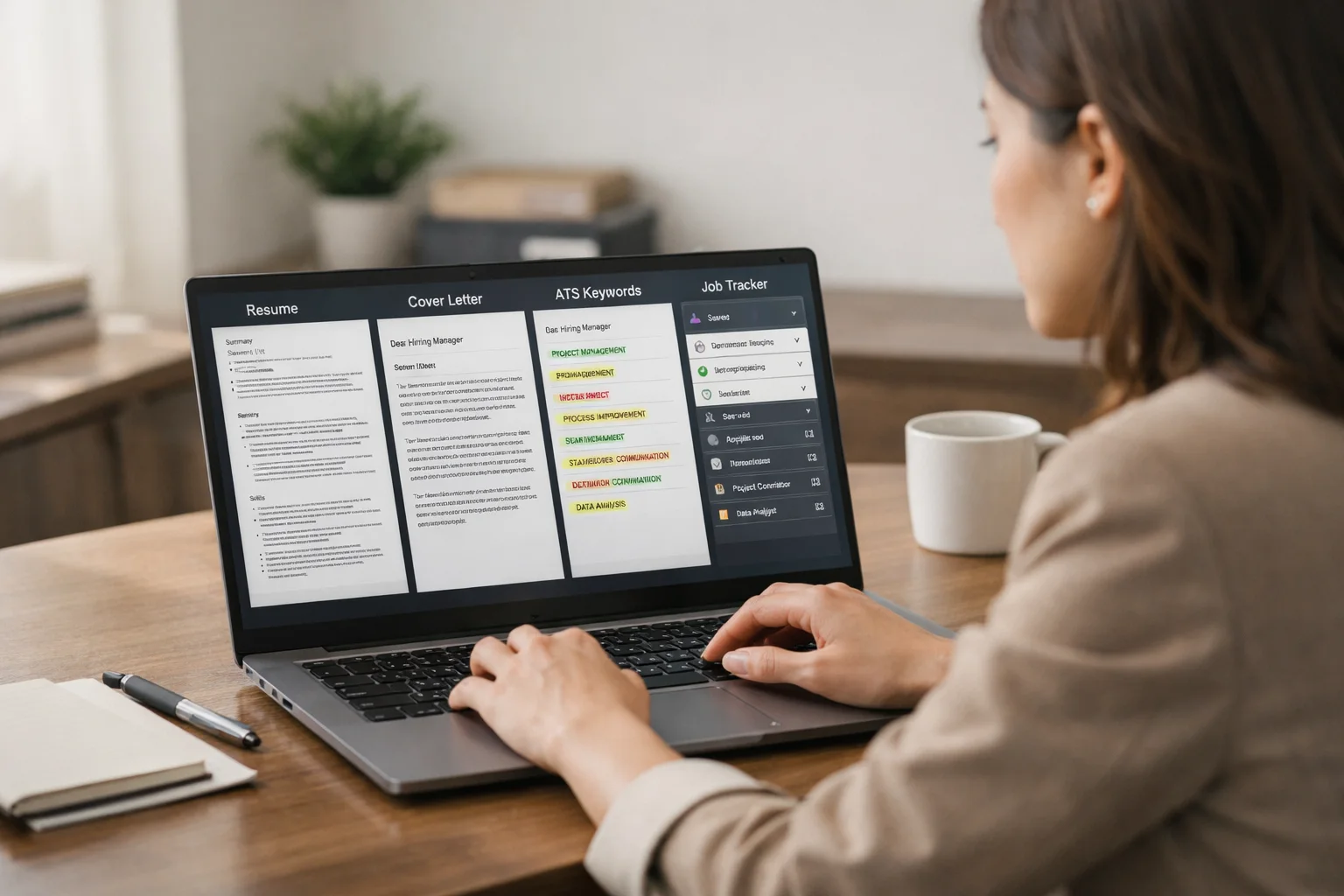
An ai powered job tracker and resume builder only earns its place if it removes real friction from the application process.
That is where many tools still fall short. One tool helps you rewrite bullets. Another gives you an ATS score. Another stores job links. Then a spreadsheet ends up carrying the rest. The result is not a system. It is admin work disguised as productivity.
A better workflow is more connected. You start with your base resume and a target job description. You tailor the resume, generate a matching cover letter, review keyword guidance, export clean files, and keep that application tied to the exact documents you sent.
That is the difference between a writing tool and a job-search workflow.
Short Answer
A good AI-powered job tracker and resume builder should connect each job, tailored document, and next step in one place.
If you apply only occasionally, separate tools can be enough. If you are applying repeatedly, one connected workflow is usually faster, cleaner, and much harder to mess up.
What Most Tools Still Get Wrong
Most products in this category are still built around isolated features rather than the full application process.
Some are tracker-first. They are useful for logging roles, interview dates, and follow-ups, but the real document work still happens elsewhere.
Some are ATS-first. They can highlight missing keywords or skill gaps, but they still leave you doing the actual rewriting, alignment, and file management by hand.
Some are resume-first. They can help produce a polished draft, but once you start managing several versions for several jobs, the workflow becomes fragile very quickly.
That matters because the hard part of an active job search is rarely writing one better resume. It is keeping the right version attached to the right role, with the right cover letter, at the right time, without repeating the same work every day.
What to Look for in an AI-Powered Job Tracker and Resume Builder
The best tools tend to get a few practical things right.
The role, tailored resume, cover letter, status, and notes should stay connected, because version confusion is one of the easiest ways to create avoidable mistakes.
- Application-level organization
A useful tool should respond to a real job description, because polished generic content still fails when every application sounds the same.
- Job-specific tailoring
A score by itself is weak. What matters is whether the tool shows which keywords, skills, or phrasing gaps are worth fixing.
- ATS guidance you can act on
The workflow should end with documents you can actually send, not a draft that still needs formatting rescue in another app.
- Clean export readiness
The value of the tool should grow as you apply to more roles, which means saved history, reusable profiles, and clear document continuity matter more than flashy first-use output.
- Repeat-use structure
Why One Connected Workflow Usually Wins
A connected workflow reduces switching costs.
You are not copying text from a chat window into a resume editor, then moving to another tool for a cover letter, then logging the role in a spreadsheet, then trying to remember which PDF belongs to which company. You stay inside one process from start to finish.
That creates real advantages:
- fewer version mistakes
- less repeated editing
- better consistency between resume and cover letter
- faster follow-up because the application record already exists
- less mental load when you are applying to multiple roles in the same week
This is also where HireDraftAI makes the strongest case. It is built as a structured job-application workflow rather than a blank AI chat. You can move from base resume and job description to tailored CV, matching cover letter, ATS guidance, PDF-ready export, saved document history, and built-in tracking in one place.
For people applying regularly, that structure is often more valuable than having a long list of disconnected features.
If that is the part of the process slowing you down, HireDraftAI is worth looking at.
A More Realistic Example
Imagine you apply to three operations roles in one week.
The first role leans heavily on process improvement. The second cares more about stakeholder coordination and cross-functional communication. The third is centered on reporting, documentation, and KPI visibility.
A weak workflow gives you three loosely edited copies of the same resume and a cover letter that still sounds generic.
A stronger workflow lets the emphasis shift with the role. In the first version, you push process mapping, workflow fixes, and efficiency gains higher. In the second, you bring forward collaboration, vendor or team coordination, and communication-heavy work. In the third, you move reporting tools, dashboards, documentation, and data accuracy closer to the top.
That difference is small in theory and huge in practice. It is how one base profile becomes three more believable applications without turning into three separate rewrite projects.
When Separate Tools Are Still Fine
Not everyone needs an all-in-one platform.
If your top priority is highly decorative templates, a design-led resume builder may suit you better.
If your main goal is only keyword diagnostics, a specialized ATS tool may go deeper in that single area.
If you apply once in a while and already have a personal system you trust, piecing together separate tools may be perfectly reasonable.
But if your real bottleneck is handling the full path from job description to tailored application without losing control of files, versions, and follow-ups, separate tools often add more friction than they remove.
Approved Free Tool CTA
Audit your current tracker first; if the workflow is scattered, use that as the upgrade signal.
Primary free tool: application tracker health score.
Source and Editorial Note
This article was reviewed after manual SEO approval on 2026-07-05. It uses official and primary references where claims need grounding, and it avoids claiming that a resume score, keyword tool, or AI workflow can guarantee interviews.
Final Verdict
The best ai powered job tracker and resume builder is not the one with the most features. It is the one that helps you move from job description to finished application with less repetition, fewer mistakes, and better control.
For occasional applicants, separate tools can still do the job. For repeat applicants, a connected workflow is usually the smarter choice.
That is the case for HireDraftAI. It is not positioned as a generic AI drafting tool. It is built for the repeated, messy reality of applying to multiple jobs and keeping each application organized. If that is your problem, it is a more useful fit than another disconnected tool in the stack.