Use Cases · Published May 2, 2026
A strong English resume is not about sounding native. It is about making your experience easy to read, easy to trust, and easy to match with the job.

ATS-Friendly Resume AI for Non-Native English Speakers Applying in English
- Title
ats-friendly-resume-ai-non-native-speakers
- Slug
Use ATS-friendly resume AI to write clearer English resumes, match job keywords, avoid generic AI wording, and apply with confidence.
- Description
Non-native English speakers often have strong experience, but their resumes can make recruiters work too hard. This guide shows how to use AI to write clearer, ATS-friendly English applications without sounding generic.
- Excerpt
Use Cases
- Category
ATS resume, AI resume, non-native English speakers, resume AI, international applicants
- Tags
HireDraftAI Editorial Team
- Author
A strong English resume is not about sounding native.
- Hero Intro
It is about making your experience easy to read, easy to trust, and easy to match with the job.
Last updated: May 2026
- Body Markdown
Overview
Many non-native English speakers lose interview opportunities not because their experience is weak, but because their resume makes recruiters work too hard.
The English may be understandable, but the job titles may not translate cleanly. The bullets may describe tasks without showing impact. The resume may miss the exact keywords used in the job description. And when AI is used badly, it often makes the resume sound smoother while removing the details that made the candidate credible.
That is why an ATS-friendly resume AI tool for non-native English speakers should do more than fix grammar. It should help you translate your real experience into clear, job-specific English that both recruiters and applicant tracking systems can understand.
The goal is not to sound like someone else. The goal is to remove unnecessary language friction so employers can understand your value faster.
Short Answer
The best ATS-friendly resume AI for non-native English speakers is not the tool that makes your resume sound the most fluent. It is the tool that keeps your experience accurate while improving clarity, keyword alignment, structure, and evidence.
A good AI resume workflow should help you:
- rewrite awkward English into clear professional phrasing
- match your resume to the language of the job description
- explain foreign job titles, education, or experience more clearly
- avoid vague AI phrases that sound impressive but say little
- export a clean resume that ATS systems can parse
- save each tailored version so you know what you sent
If you are applying to several English-language jobs, HireDraftAI can help you move from job description to tailored CV, cover letter, ATS guidance, PDF export, and application tracking in one connected workflow.
Start here: https://hiredraftai.com/
Editorial Note
This guide is written for international applicants, immigrants, students, graduates, and professionals applying for English-language roles. It focuses on truthful resume tailoring, ATS-readable formatting, clear recruiter communication, and responsible use of AI in job applications, especially for people applying outside their first-language job market.
The Real Problem: Your Resume Is Being Translated Twice
Non-native applicants are not only translating words. They are translating professional context.
A recruiter may not know what your previous company does. They may not recognize a local job title from your home country. They may not understand whether your degree, project, internship, part-time role, or earlier work experience is relevant to the position.
This creates two layers of translation.
First, your experience must be translated into English.
Second, your experience must be translated into the hiring language of the role.
That second part is where many resumes fail. A resume can be grammatically correct and still be weak if it does not use the right role keywords, structure achievements clearly, or show why your background fits the job.
For example, a candidate may write:
“Made reports for manager.”
That sentence is understandable. But it does not show the tool, purpose, audience, or business context.
A stronger version would be:
“Prepared weekly Excel reports for managers to track operational performance, delays, and recurring data quality issues.”
The second version is not more complicated. It is simply more useful.
The 5 Resume Translation Gaps Non-Native English Speakers Must Fix
1. Language Gap
The language gap is the most obvious one. Your resume may contain phrases that are understandable but not natural in English resume writing.
Weak:
“Made support for office users about computer problems.”
Better:
“Provided IT support to office employees, troubleshooting Windows, Microsoft 365, printer, and account-access issues.”
2. Job-Title Gap
Job titles do not always travel well across countries.
A title that makes sense in your local market may sound too broad, too junior, or unfamiliar in English. For example, “IT Officer” may mean help desk support, system administration, office technology support, vendor coordination, or all of those depending on the country and company.
If you are applying for an IT Support Engineer role, your bullets should clarify the actual work:
- user support
- ticket handling
- endpoint troubleshooting
- Microsoft 365 support
- account setup
- basic network troubleshooting
- escalation to second or third-level teams
AI can help map your real responsibilities to the target role. But it should not rename your job dishonestly. Keep the official title, then make the responsibilities clear.
3. Keyword Gap
Many non-native English speakers describe the right skill using the wrong phrase.
You may write “made reports from data,” while the job description says “Power BI dashboards,” “SQL queries,” “business intelligence,” “data quality,” or “stakeholder reporting.”
The experience may be relevant, but the match is hidden.
Bad keyword use:
“Power BI, Power BI, Power BI, dashboard, dashboard, data, analytics, reporting.”
Better keyword use:
“Built Power BI dashboards using operational data to support weekly stakeholder reporting and identify recurring data quality issues.”
The second version includes keywords naturally because they are connected to real work.
4. Achievement Gap
Some applicants come from work cultures where resumes focus on duties, not evidence. English-language resumes often expect more context.
Weak:
“Responsible for customer communication.”
Better:
“Handled customer inquiries by email and phone, documented cases in the CRM, and escalated unresolved issues to the technical support team.”
When numbers are available, use them. When numbers are not available, use context. Tools, users, systems, workflows, frequency, and business purpose can all make a bullet stronger.
5. Formatting Gap
An ATS-friendly resume should be easy for software and humans to read.
For non-native English speakers, formatting matters even more because the recruiter may already need extra context. Do not make the document harder to scan with columns, icons, graphics, text boxes, unusual section names, or decorative layouts.
Use:
- standard section headings
- simple bullet points
- consistent dates
- clear job titles
- readable spacing
- a clean single-column layout
- simple file naming
A resume can sound beautifully written and still perform poorly if it hides the information recruiters and ATS systems need.
Mini Example: From Unclear Experience to Recruiter-Ready English
Imagine a non-native applicant applying for an IT Support role in Germany, the UK, or another English-language job market.
Original bullet:
“Helped office people with computer, internet, email and system problems.”
This is understandable, but it is too broad. It does not show tools, support level, or work context.
Improved bullet:
“Provided first-level IT support for internal employees, resolving Windows, Microsoft 365, Wi-Fi, printer, and account-access issues, and escalating complex tickets to the infrastructure team.”
What changed?
- “office people” became “internal employees”
- “computer, internet, email” became clearer technical categories
- “helped” became “provided first-level IT support”
- escalation was added to show process maturity
- the bullet now matches common IT Support job descriptions
The experience did not change. The translation became stronger.
What “ATS-Friendly” Really Means for Non-Native English Speakers
ATS-friendly does not mean tricking the system. It means making your resume readable, relevant, and structured.
For non-native English speakers, this usually means:
- use standard headings such as Summary, Skills, Experience, Education, and Certifications
- include exact tools and skills when they are relevant
- mirror job-description keywords only when they are truthful
- avoid long paragraphs under work experience
- use direct action verbs
- keep formatting simple
- export in the format requested by the employer
- check that your contact details, dates, job titles, and section headings parse cleanly
The best ATS-friendly resume is not overloaded with keywords. It is clear enough for software to parse and specific enough for a recruiter to trust.
How AI Should Improve a Non-Native English Resume
AI should improve your resume in layers.
First, it should clean up grammar and phrasing. This includes awkward wording, unclear verbs, long sentences, and phrases that do not sound natural in English resume writing.
Second, it should help translate your experience into the target role’s language. If you are moving from one country, industry, or job title to another, this is essential.
Third, it should compare your resume against the job description and surface keyword gaps.
Fourth, it should improve structure. A good resume AI should help decide what belongs in the summary, skills, and experience sections.
Fifth, it should help you keep versions organized, especially if you apply to multiple jobs.
This is where structured resume AI is more useful than a blank chat. A blank chat can rewrite text, but it does not automatically manage your job description, CV version, cover letter, ATS guidance, PDF export, and application status in one place.
Blank AI Chat vs Structured Resume AI Workflow
Many non-native English speakers use a blank AI chat because it feels flexible. The problem is that flexibility can become messy when you apply to many jobs.
| Application Step | Blank AI Chat | Structured Resume AI Workflow | | --------------------- | --------------------------- | ------------------------------- | | Paste job description | Manual every time | Built into the workflow | | Compare keywords | Requires a separate prompt | Included in ATS guidance | | Rewrite resume | Possible, but inconsistent | Tailored to the specific job | | Create cover letter | Requires another prompt | Generated from the same context | | Keep formatting clean | Must be checked manually | Designed for PDF-ready export | | Save versions | Manual file management | Saved document history | | Track applications | Separate spreadsheet needed | Built-in application tracking |
For non-native English speakers, the biggest advantage is not only better wording. It is consistency. A structured workflow reduces the risk of sending the wrong version, forgetting which resume matched which job, or slowly turning your resume into generic AI text.
A Simple AI Resume Prompt for Non-Native English Speakers
If you use AI to improve your English resume, do not only ask:
“Make my resume better.”
That instruction is too broad. It often creates polished but generic text.
Use a more specific prompt:
“Rewrite my resume for this job description. Keep every claim truthful. Improve unclear English, use relevant keywords from the job description only when they match my real experience, remove generic AI phrases, and keep the resume ATS-friendly with simple headings and bullet points. Do not invent achievements, tools, metrics, or seniority.”
This kind of instruction helps AI improve clarity without turning your resume into something inaccurate.
A good resume should sound professional, but it should still sound like a real person with real experience.
If you want this process without rebuilding the prompt every time, HireDraftAI helps you create tailored resumes, cover letters, ATS guidance, and saved application versions from one workflow.
The Biggest Mistake: Sounding Too Perfect
Many non-native English speakers worry that their resume does not sound native enough. That fear is understandable, but over-polishing can make the resume weaker.
Bad AI output often sounds like this:
“Dynamic and results-driven professional with a passion for leveraging innovative solutions to drive operational excellence.”
That sentence is fluent, but it is almost empty.
A stronger version is:
“Data analyst with experience building Power BI dashboards, writing SQL queries, checking data quality issues, and supporting operational reporting.”
The second version is less dramatic. It is also more trustworthy.
Recruiters do not need every sentence to sound like marketing copy. They need to understand your tools, responsibilities, experience level, and fit for the role.
What You Should Never Let Resume AI Do
AI can improve your resume, but it should not take control of your professional identity.
Do not let AI:
- invent numbers you cannot prove
- add tools you have never used
- upgrade your seniority without evidence
- rename your job title dishonestly
- turn simple work into exaggerated corporate language
- remove important country-specific or industry-specific context
- create bullets you would not feel comfortable explaining in an interview
A good test is simple: if a recruiter asks about the bullet in an interview, can you explain it confidently with a real example?
If not, remove it or rewrite it.
Before and After Resume Phrasing Examples
IT Support
Weak:
“Solved computer problems for office workers.”
Better:
“Provided first-level IT support for internal employees, troubleshooting Windows, Microsoft 365, printer, network, and account-access issues.”
Data Analyst
Weak:
“Made reports from company data.”
Better:
“Built Excel and Power BI reports using operational data to help managers track performance, delays, and recurring data quality issues.”
Customer Service
Weak:
“Handled customer communication and complaints.”
Better:
“Responded to customer inquiries by email and phone, documented cases in the CRM, and escalated unresolved issues to the relevant support team.”
Operations
Weak:
“Controlled daily work and helped team.”
Better:
“Coordinated daily operational tasks, monitored progress, and supported team members during high-volume periods.”
Software Testing
Weak:
“Responsible for testing software and finding mistakes.”
Better:
“Tested software features, documented defects, and worked with developers to verify fixes before release.”
Project Coordination
Weak:
“Helped project manager with project works.”
Better:
“Supported project coordination by tracking tasks, updating project documentation, preparing status notes, and following up with stakeholders on open items.”
Administrative Support
Weak:
“Did office work and managed documents.”
Better:
“Managed administrative documents, updated internal records, coordinated appointments, and supported daily office communication.”
These examples work because they add context without exaggeration. They show tools, processes, users, systems, or outcomes. That is what makes resume English stronger.
A Practical 15-Minute Resume AI Workflow
Use this process before sending an application.
- Paste the full job description into your AI resume tool.
- Add your current resume or saved profile.
- Ask for the main role requirements and keyword gaps.
- Generate a tailored resume version for that job.
- Review every bullet for truth and remove anything invented.
- Replace vague AI phrases with specific tools, tasks, or outcomes.
- Check that the document is clean, single-column, and ATS-readable.
- Export the resume in the required format.
- Save the version under the company and job title.
- Track the application so you know exactly what you sent.
This process prevents the biggest AI resume problem: creating a polished document that is disconnected from the real job and your real background.
Better means better for this role, in this market, with your real experience.
What to Check Before Sending Your Resume
Before you apply, read the final resume like a recruiter with limited time.
Ask yourself:
- Can the recruiter understand my target role within 10 seconds?
- Does the summary match the job I am applying for?
- Are the most important tools and skills visible?
- Are my job titles and responsibilities clear in English?
- Do the bullets show evidence, not only duties?
- Does every claim reflect my real experience?
- Is the formatting simple enough for an ATS?
- Did I avoid generic AI phrases?
- Did I save the correct version for this company?
If the answer is no, the resume does not need more decoration. It needs clearer positioning.
Non-Native English Resume Checklist
Before you send your resume, check whether it passes these questions:
- Is my target role clear in the first 10 seconds?
- Did I use the job description’s keywords only where they match my real experience?
- Are my job titles understandable to someone outside my country?
- Did I explain tools, systems, users, processes, or outcomes in my bullets?
- Did I remove vague phrases such as “dynamic,” “results-driven,” and “passionate professional”?
- Is every achievement truthful and easy to explain in an interview?
- Is the resume clean, single-column, and easy for ATS systems to parse?
- Did I save this version under the company and job title?
- Does my cover letter match the same positioning as the resume?
- Would a recruiter understand why I fit this role without guessing?
If the answer is no to several of these, the resume does not need more polish. It needs clearer translation of your experience.
Why HireDraftAI Fits This Use Case
The hardest part for many non-native English speakers is not writing one resume. It is repeating the process for every job without losing accuracy, formatting, or confidence.
A blank AI chat can help with wording, but it does not automatically manage the full application workflow. You still need to paste the job description, compare keywords, rewrite the CV, create a cover letter, export the file, save the version, and remember where you used it.
HireDraftAI is designed to keep those steps connected.
It supports:
- tailored CV generation
- tailored cover letter generation
- ATS score and keyword guidance
- PDF-ready exports
- saved document history
- resume profiles
- built-in job application tracking
That structure is especially useful for non-native English speakers because the goal is not only better English. The goal is a more controlled application process where each job gets a relevant, truthful, and ready-to-send document set.
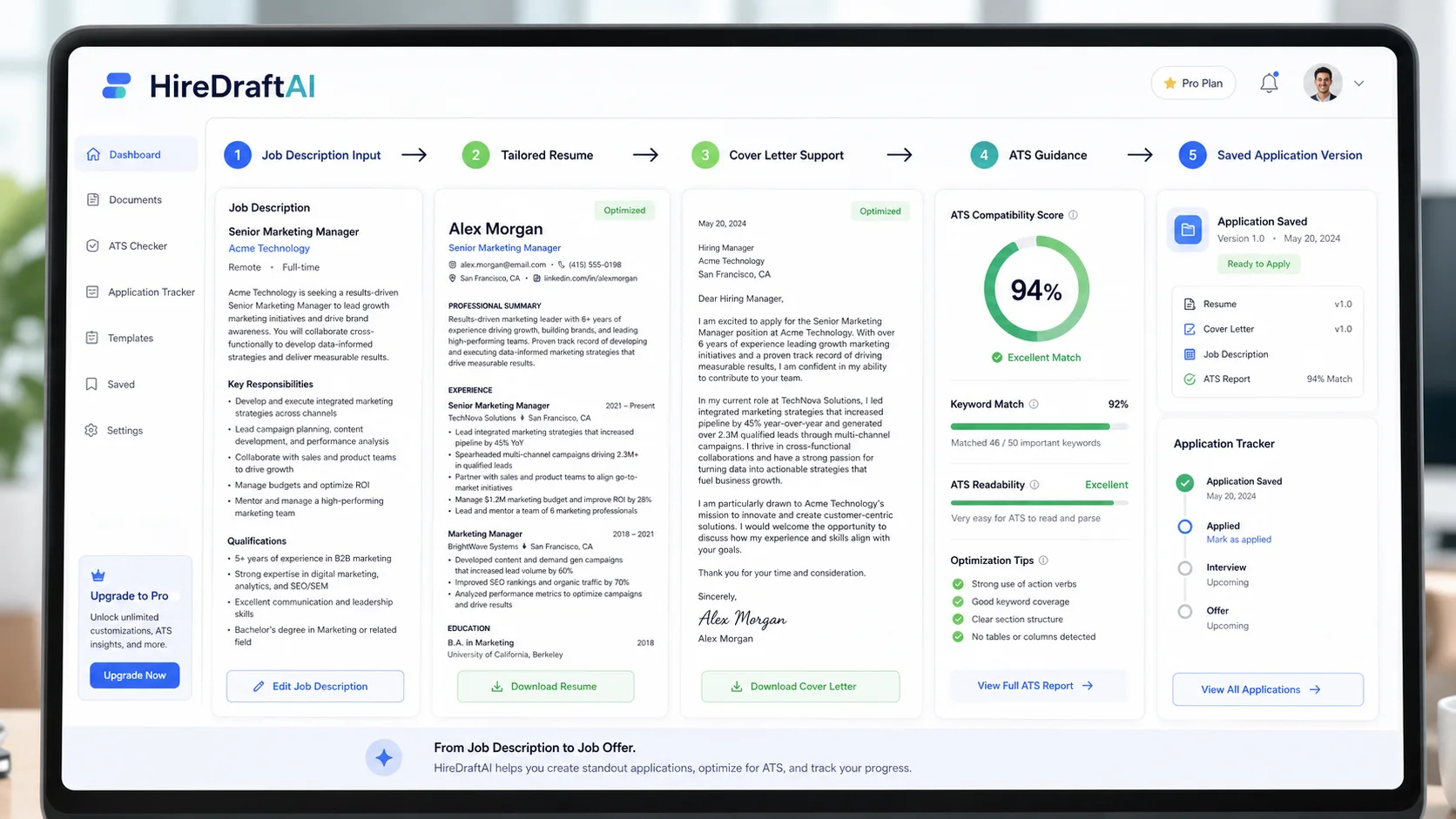
Example workflow: turn a job description into a tailored resume, matching cover letter, ATS guidance, and saved application version in HireDraftAI.
Turn This Into a Tailored Application
If you are applying in English, do not only rewrite your resume once. Tailor it for each role.
With HireDraftAI, you can paste a job description, generate a tailored CV, create a matching cover letter, review ATS keyword guidance, export PDFs, save each version, and track your applications from one workflow.
Start your next application here: https://hiredraftai.com/
You May Also Find These Guides Useful
- Free AI Resume for International Students: https://hiredraftai.com/blog/free-ai-resume-for-international-students-fix-these-5-context-gaps
- More career application guides: https://hiredraftai.com/blog
Approved Free Tool CTA
Check whether the resume reads clearly before adding more keywords.
Primary free tool: resume readability score.
Source and Editorial Note
This article was reviewed after manual SEO approval on 2026-07-05. It uses official and primary references where claims need grounding, and it avoids claiming that a resume score, keyword tool, or AI workflow can guarantee interviews.
FAQ
Can AI make my English resume sound more professional?
Yes, but the goal should be clarity, not artificial polish. A good AI resume tool should improve grammar, phrasing, structure, and keyword alignment while keeping your real experience accurate.
Should non-native English speakers mention that English is not their first language?
Usually, no. Your resume should focus on your skills, experience, tools, achievements, and language level only when it is relevant to the job.
Is an ATS-friendly resume different for non-native English speakers?
The basic structure is the same, but non-native English speakers often need extra care with job-title translation, keyword matching, direct verbs, achievement wording, and simple formatting.
Can AI rewrite my resume from another language into English?
Yes, but direct translation is rarely enough. English resumes use specific job-market phrasing, achievement style, and keywords. Always review the AI output carefully before sending it.
What should I avoid when using AI for my resume?
Avoid invented achievements, exaggerated seniority, vague corporate language, keyword stuffing, and formatting that looks beautiful but is difficult for ATS systems to parse.
What is the best way to use AI for an English resume?
Use AI with your real resume and the full job description. Ask it to improve clarity, align truthful keywords, keep the formatting ATS-friendly, and avoid inventing anything.
Final Resume Check
Before sending your resume, check three things: does it match the job, does it sound truthful, and can a recruiter understand your fit quickly?
Final Verdict
An ATS-friendly resume AI for non-native English speakers should not make you sound like someone else. It should help employers understand your experience faster.
The strongest English resume is not the most polished. It is the clearest, most accurate, and most relevant to the job.
Use AI to fix language gaps, translate job titles and responsibilities, match truthful keywords, strengthen achievement wording, and keep your format readable. But stay in control of the facts. Your resume should reflect your real work, not an invented version of you.
If you are applying in English and want a structured way to tailor your CV, create a matching cover letter, review ATS guidance, export PDFs, save versions, and track applications, start with HireDraftAI.