Use Case · Published April 23, 2026
A free AI CV builder should let a career switcher test whether their experience can translate into the target role before paying for repeated tailoring, exports, saved versions, or tracking.

Quick Verdict
A free AI CV builder for career switchers should prove one thing before it asks for money: it can translate your existing experience into credible evidence for the role you want next.
That means the free tier should let you test the hard parts:
- paste or upload your current CV
- add a target job description
- see whether your old experience can be reframed around transferable value
- identify missing keywords, unclear sections, and unsupported claims
- edit the draft yourself
- leave with at least one usable direction or export
Free does not need to mean unlimited generation forever. Paid plans can reasonably charge for repeated tailoring, cover letters, saved versions, multiple profiles, higher-volume exports, and application tracking. But a free AI CV builder that only gives a generic summary or a locked preview is not enough for a career switcher.
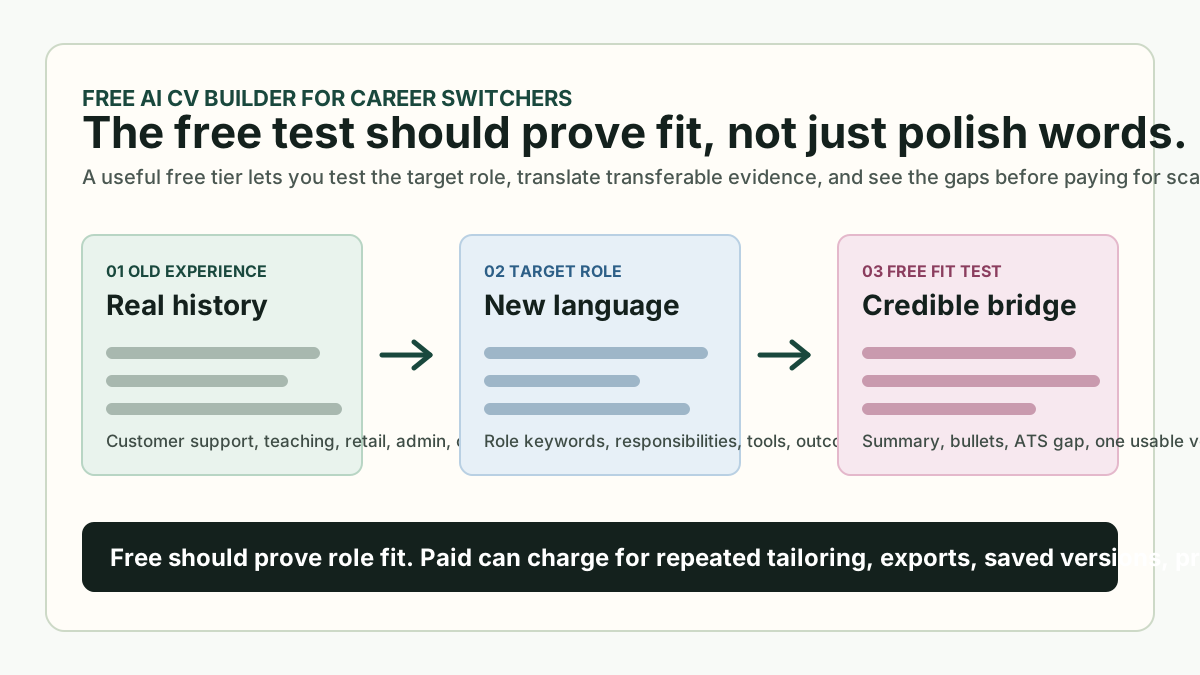
The right standard is simple: free should prove fit; paid can charge for scale.
Editorial Note
This guide was rewritten on June 5, 2026 for career switchers comparing free AI CV builders, resume builders, ATS tools, and paid application workflows.
It does not argue that every feature should be free. A serious job-search product has real compute, storage, export, and support costs. The point is narrower: career switchers need enough free access to judge whether the tool can handle the transition problem, not just produce polished wording.
Why Career Switchers Need a Different Free Test
Most free CV builder pages assume the main problem is blank-page writing.
For career switchers, that is rarely the real problem.
The real problem is translation. Your previous experience may be valid, useful, and impressive, but it may not be written in the language of the new role. A teacher moving into learning design, a retail supervisor moving into operations, or a customer support lead moving into implementation work does not need a nicer template first. They need proof that their background can be made relevant without exaggeration.
A weak AI builder turns that story into vague lines like:
- Motivated professional seeking a new challenge.
- Strong communicator with a passion for learning.
- Results-driven candidate with transferable skills.
Those lines are not always false. They are just too thin.
A stronger AI CV builder asks what the target role actually wants and turns real experience into role-relevant evidence:
- Coordinated daily issue resolution for 40 to 60 customer cases while documenting repeat problems for operations handoff.
- Built lesson plans, feedback loops, and learner progress reports that translate well to learning design and enablement work.
- Managed shift coverage, inventory checks, vendor follow-up, and team handovers in a high-volume retail environment.
That is the difference a free test should reveal.
What Should Be Free
Use this table when judging a free AI CV builder for career switchers.
| Free feature | Why it matters for switchers | When paid is reasonable | | --- | --- | --- | | CV paste or upload | The tool needs your real experience, not a blank prompt. | Larger file storage, multiple profiles, and saved libraries. | | Target job description input | Switching careers only makes sense against a specific role. | Bulk tailoring across many roles. | | Transferable-skill rewrite | The tool must bridge old work to new requirements. | Multiple polished versions and tone variants. | | ATS or keyword feedback | You need to know which terms are missing or weak. | Deep scoring, repeated scans, and saved reports. | | Manual editing | The user must keep control of truth and tone. | Advanced editor features, version compare, and export history. | | One usable output or clear preview | Free should prove the workflow can work. | Unlimited exports, branded templates, PDFs, and cover letters. | | Honest limitations | A good tool should say what it cannot infer. | Human review, coaching, or premium support. |
If a free builder blocks all output before you can judge relevance, it is not really a free test. If it gives unlimited generic text but no role-fit signal, it is also not a useful test.
What Can Fairly Be Paid
Paid features make sense when they support repeated application work.
Career switchers often explore more than one path. A customer support lead might test customer success, implementation, operations coordinator, and product support roles. A teacher might test learning design, training coordinator, curriculum specialist, and customer education roles. Each direction needs different emphasis.
It is reasonable for paid tools to charge for:
- unlimited tailored CVs
- matching cover letters
- saved version history
- multiple resume or CV profiles
- PDF-ready exports
- application tracking
- higher usage limits
- deeper ATS and keyword guidance
- support for repeated job-description matching
The question is not "should everything be free?" It should not. The question is whether the free tier gives enough evidence to decide whether the product understands career switching.
The 7-Part Test for a Free AI CV Builder
Before paying for any AI CV builder, run these seven checks.
1. Can it use the job description?
A career switch CV cannot be judged in isolation.
The same background can be framed very differently for operations, enablement, customer success, HR coordination, data analysis, or project support. If the tool does not let you add the job description, it is guessing.
Start by extracting the role language with the job description keyword extractor, then compare whether the CV builder reflects the same priorities.
2. Does it identify transferable proof?
Transferable skills are not just adjectives.
"Communication" is weak. "Handled escalations, wrote follow-up summaries, and coordinated handoff between customers and technical teams" is stronger. "Leadership" is weak. "Trained five new team members and managed shift handovers during peak periods" is stronger.
A good free AI CV builder should help move from label to evidence.
3. Does it avoid unsupported claims?
Career switchers are vulnerable to overcorrection.
If you are moving into data analysis, the tool should not invent SQL ownership if you only used spreadsheets. If you are moving into project management, it should not claim formal project manager experience if you coordinated tasks informally.
The best tools improve relevance without changing your identity.
4. Does it show ATS gaps without keyword stuffing?
ATS guidance matters, but it should not turn the CV into a keyword dump.
The free tier should show missing terms, weak context, and possible role-language gaps. Then it should help place truthful terms inside the summary, skills, and experience bullets.
Use a resume keyword matcher if you want a quick second check before rewriting.
5. Does the output sound like a person?
Career switchers need confidence, not corporate fog.
Bad AI writing often adds phrases like "dynamic professional," "proven track record," and "passionate about leveraging skills." Stronger writing is concrete, calm, and specific.
The best free test is whether the summary and bullets still sound like you after the AI helps.
6. Can you edit the draft?
AI should not lock the final story.
You need to remove claims that feel too strong, add details the model missed, and adjust the angle for the target role. If a free builder gives a sealed preview with no editing control, it is hard to trust for a real career switch.
7. Does it connect to the next step?
A CV is not the whole application.
Once the CV direction is right, you may need a cover letter, ATS check, PDF export, saved version, and tracker entry. A free builder does not need to provide all of that forever, but it should make the next step obvious.
Example: From Customer Support to Operations Coordinator
Imagine your current CV says:
Customer support representative with strong communication skills and experience helping customers solve problems.
That is true, but it is too broad for an operations coordinator role.
A better career-switch rewrite might say:
Customer support professional with four years of experience coordinating daily issue resolution, documenting recurring workflow problems, and improving handoffs between customers, internal teams, and service partners. Strong fit for operations coordinator roles that require follow-through, process clarity, and cross-functional communication.
The better version works because it:
- names the target direction
- keeps the experience truthful
- translates support work into operations language
- uses evidence instead of personality claims
- avoids pretending the person already held the new title
This is what a free AI CV builder should help you test.
Red Flags in Free AI CV Builders
Be cautious if the tool does any of these:
- writes a generic career-change summary without asking for a target role
- hides the useful output behind a paywall before you can judge quality
- creates claims that are not supported by your CV
- focuses only on templates and fonts
- gives no ATS or keyword visibility
- cannot compare your CV to a job description
- produces the same language for different target roles
- makes every career switch sound like a motivational essay
- gives no way to edit or export anything useful
Pretty output is not enough. A career switch CV has to survive recruiter scanning, ATS parsing, and the basic credibility test: does this move make sense?
Where HireDraftAI Fits
HireDraftAI is built for the point where a free test becomes repeated application work.
A free diagnostic or first generation should help you decide whether the target direction is viable. After that, the harder problem is applying consistently: tailoring the CV, creating a matching cover letter, checking ATS alignment, exporting clean files, saving versions, and tracking where each application went.
That is where a connected workflow matters.
Use the ATS resume checker if you want to diagnose the current CV first. Use HireDraftAI pricing if you are deciding whether the full workflow is worth it for repeated applications.
A 15-Minute Free Test Before You Pay
Before upgrading any AI CV builder, run this quick test.
- Pick one real job description for the role you want next.
- Paste your current CV without rewriting it first.
- Ask the tool to identify transferable evidence, not just rewrite the summary.
- Check whether the suggested keywords are truthful.
- Compare the new summary with the original job description.
- Read every claim and mark anything you could not defend in an interview.
- Export or copy one usable version.
- Decide whether the paid plan would save time across five or more applications.
If the tool cannot pass this test, do not pay yet.
Final Verdict
A free AI CV builder for career switchers should not promise to solve an entire career transition for free.
It should do something more practical: show whether your existing experience can be translated into the language of the target role without becoming generic or dishonest.
The free tier should prove role fit, surface ATS gaps, and give you enough editable output to judge quality. Paid plans can charge for scale: repeated tailoring, cover letters, saved history, exports, profiles, and tracking.
If the builder helps you sound credible for the role you want next, it is worth considering. If it only makes your old CV sound smoother, keep looking.
FAQs
What is a free AI CV builder for career switchers?
It is a tool that helps someone moving into a new field rewrite their CV around transferable experience. The useful version lets you compare your current CV with a target job description, not just generate a generic resume.
Should a free AI CV builder include ATS feedback?
Yes, at least at a basic level. Career switchers need to know whether the CV includes role language, clear sections, and relevant keywords. The tool should warn about gaps without encouraging keyword stuffing.
Is one free CV enough to judge a tool?
Usually yes, if the output is complete enough to read and edit. One real target job is enough to see whether the tool can translate your background credibly. Repeated tailoring can reasonably be paid.
What should not be free forever?
Unlimited CVs, repeated cover letters, saved version history, multiple profiles, PDF exports, deep ATS reports, and application tracking can fairly sit inside a paid plan.
Can AI write a career-change CV without exaggerating?
It can help, but you still need to review every claim. The safest tools reframe evidence you actually have. They should not invent tools, metrics, leadership scope, certifications, or job titles.
What is the biggest mistake career switchers make with AI CV tools?
They ask for a better CV before choosing a target role. The target role controls which experience matters, which keywords belong, and which achievements should move higher.
How do I know if the AI CV is good?
A good career-switch CV makes the move feel logical. It names the target direction, uses truthful evidence, reflects the job description, avoids filler, and gives the recruiter a clear reason to keep reading.