Resume credentials · Published September 27, 2026
Use letters after your name only for current, recognized credentials that materially help a reader evaluate you; place the rest in a labeled section.

Put a credential after your name when it is current, widely recognized in your profession, relevant to the target role, and normally written as a post-nominal. Licenses and regulated professional designations often qualify. Most degrees, short-course certificates, online badges, and software training do not need to follow your name; list them in Education, Licenses, or Certifications with the issuer and date where useful.
The purpose is fast verification, not prestige stacking. If a reader cannot tell what the letters mean, or could mistake a course certificate for a professional license, the placement weakens clarity.
Run the NAME test
Check Norm, Authority, Materiality, and Expiry.
| Test | Ask | Include after name when… | |---|---|---| | Norm | Is post-nominal use established in this profession? | Peers and governing bodies commonly use it | | Authority | Who issued or regulates it? | A recognized licensing or certifying body stands behind it | | Materiality | Does it affect eligibility or specialist fit? | The target role values or requires it | | Expiry | Is it current and in good standing? | You can accurately claim it today |
A credential can belong on the resume without passing the NAME test. The test determines name-line treatment, not whether education is valuable.
Check the credential owner's rule before any resume rule
The NAME test starts with Norm for a reason. Many credential bodies publish their own rules for how a designation may be displayed, and those rules are more useful than a generic list of credentials that supposedly always belong after a name.
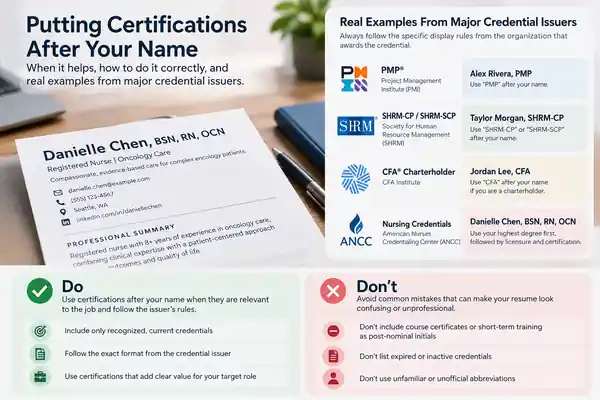
- PMP: PMI says an authorized credential may appear immediately after the certification holder's name, for example, "Joseph Smith, PMP."
- SHRM-CP / SHRM-SCP: SHRM tells people who earn these certifications to use the designation letters after their name.
- CFA: CFA Institute tells charterholders in good standing to use "CFA" after their name on a resume or CV. It separately says its certificate programs are not designations and should not be turned into post-nominal initials.
- Nursing credentials: ANCC publishes a profession-specific order: highest earned degree, licensure, state designations, national certifications, awards, then other recognition.
That distinction matters. A credential can be respected and relevant without giving you the right, or a good reason, to turn it into letters after your name. If the issuer does not authorize a post-nominal, use the full credential name in a labeled section instead.
Separate four credential types
A license grants legal permission in a jurisdiction or regulated activity. A professional certification verifies defined competence through a recognized body. A degree documents an academic award. A course certificate usually confirms completion of training. Employers may value all four, but they are not interchangeable.
Use precise labels. Name the issuer, credential, and status; add an expiry or expected date when material. Never shorten a course name into letters that resemble a regulated designation. If a certification has a public verification link, include it only when the destination is stable and does not expose unnecessary personal data.
Worked example: nursing shows why professional convention matters
Danielle is a registered nurse applying for an oncology role. She holds a BSN, an active RN license, a current oncology specialty certification, and three continuing-education completion certificates.
Under ANCC's preferred ordering convention, her professional name line would be Danielle Chen, BSN, RN, OCN: highest earned degree first, then licensure, then national certification. The continuing-education certificates do not become extra initials after her name. They belong in professional development or can be omitted when they do not help the target application.
This is a useful exception to a broad resume rule. A degree that would normally sit quietly in Education can belong after the name when the profession's own convention says it should. If the oncology certification had expired, Danielle should not present it as though it were current.
Keep the name line restrained
A long chain of letters slows recognition and may distract from the actual target. Follow the profession's required ordering, then avoid adding optional credentials that do not help the reader assess eligibility or specialist fit.
- Use the exact authorized abbreviation.
- Verify current status before every application cycle.
- Follow jurisdiction-specific display rules for regulated licenses.
- Put explanatory detail in a credential section.
- Distinguish "in progress" or "expected" from completed.
- Remove unrelated or obsolete designations when they add noise.
For academic, research, and international contexts, degree conventions differ. Check the employer's local norms and the professional body's current guidance rather than importing one country's private-sector pattern automatically.
Make verification easy without oversharing
A credential section can include the credential name, issuer, issue date, expiry date, and an identifier only when that identifier is intended for public professional use. Do not place identity-document numbers, scans, or sensitive records on a general resume. Provide documentation through the employer's legitimate process when requested.
Match the spelling in the job announcement when accurate. If a required credential is pending, state the real status, such as "Exam scheduled October 2026" or "License application submitted," rather than using the completed designation.
The durable approach is conservative: use the name line for current credentials that your profession or issuing body treats as post-nominals, use labeled sections for context, and make every claim verifiable.
How to list BLS on a resume
For a current Basic Life Support course-completion credential, use a Certifications or Training section rather than adding “BLS” to the name line as if it were a professional license. Write the exact course name and issuer, and include the renewal date from your actual card.
Example format: Basic Life Support (BLS) Provider — American Heart Association; renew by [Month Year]. This is a format example, not a credential to claim. Replace the issuer if yours is different, and do not imply an AHA credential when you completed another provider's course.
The American Heart Association BLS course page states that its BLS Provider Course Completion Card is valid for two years after successful completion of the course requirements. Use your card's actual dates and check the employer's requirements; do not calculate a new validity period from when you last reviewed course material.
If the credential is expired or a course is only booked, label that status accurately. A current training card, a professional certification, and a nursing or other professional license are different facts. For examples in context, see the medical assistant resume and nursing job-letter guide.
Sources and scope
- Project Management Institute: Trademark Usage Guidelines — PMI guidance says authorized credentials may appear immediately after the certification holder's name.
- SHRM: How to Get SHRM Certified — SHRM instructs successful candidates to use SHRM-CP or SHRM-SCP designation letters after their name.
- CFA Institute: How to Share Your Achievements — Official resume and CV rules for CFA designation use, candidate status, and certificate programs.
- ANCC: How to Display Your Credentials — Profession-specific guidance on the preferred order for nursing credentials.
Credential display rules vary by profession, certifying body, and jurisdiction. Candidates in regulated fields should follow the current rules of the authority that issued the designation. Editorial review: October 4, 2026.
Take the next useful step
Classify each item as a license, professional certification, degree, or course certificate. Then check whether the issuer or profession authorizes post-nominal use before placing it after your name.
- Resume Section Checker
- ATS Plain Text Preview
- Job Description to Resume Mapping
- Resume Readability Score
- Start Free
Questions readers usually ask
Should MBA go after my name on a resume?
Usually it is clearer in Education. An exception is a profession or context where degree post-nominals are customary and the letters add real decision value.
Should I put PMP, CFA, or SHRM-CP after my name?
If you currently hold the credential and remain authorized to use it, the issuing bodies for PMP, CFA, SHRM-CP, and SHRM-SCP permit or instruct holders to use those designation letters after their names. Still keep the full credential in a Certifications or Credentials section where it helps verification and keyword clarity.
Can I list an expired certification?
Only with an explicit expired or inactive status when historical context is relevant. Do not present it as current or continue using a post-nominal that requires active status.
Do course certificates count as certifications?
Not automatically. A completion certificate and a professional certification have different issuing standards and usage rules. Use the exact name the issuer provides and do not invent initials for a certificate.
How many credentials can follow my name?
Use the smallest set that establishes current eligibility or specialist authority, unless your profession has a formal credential-ordering convention that requires more. Put fuller detail in the credential section.